
For the first two months of 2026, the trade was obvious. Bitcoin was down. Gold was up. Money rotated accordingly. Gold ETFs pulled in $16 billion over three months while Bitcoin ETFs bled nearly $4.5 billion since January. The narrative wrote itself. Institutional money was rotating out of the risky digital asset and into the safe haven that had been working for five thousand years.
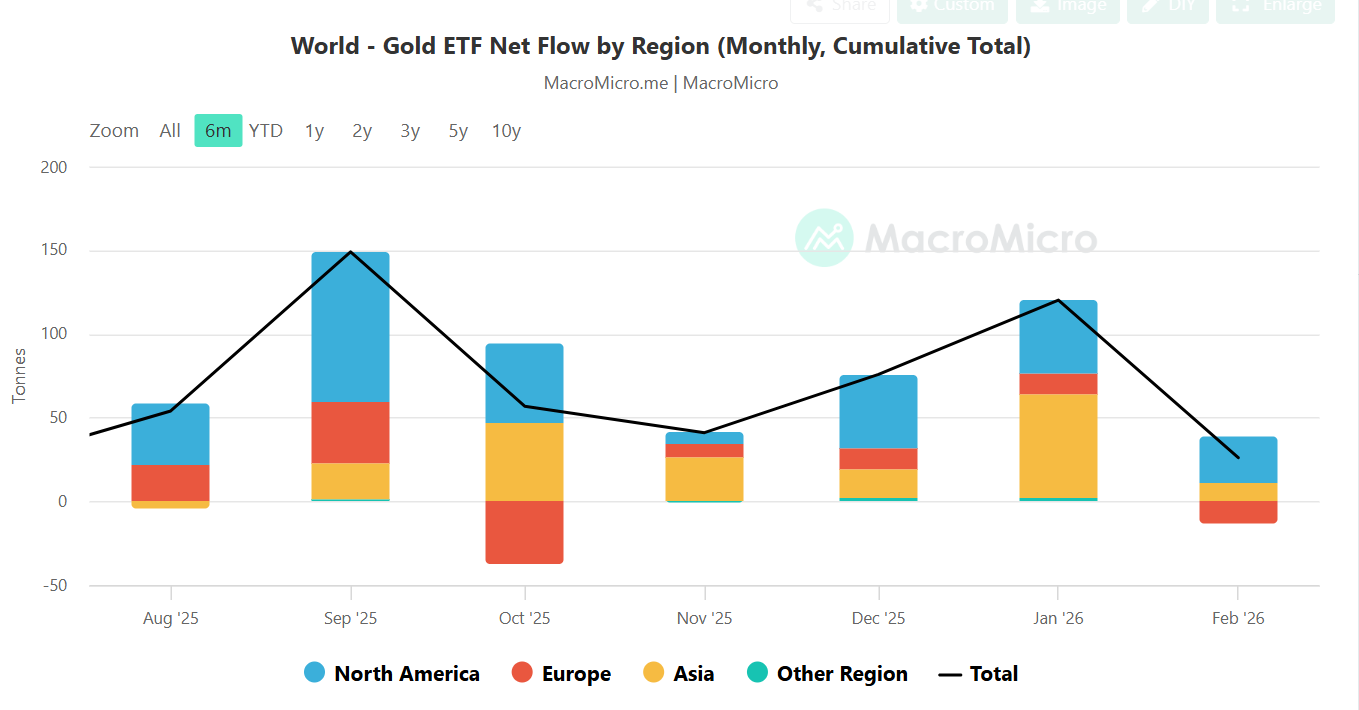
Global Gold ETF net flows by region dropped sharply in February 2026 as institutional money began rotating. (Source: MacroMicro)
Then March happened.
Bitcoin ETFs just recorded approximately $2.5 billion in capital inflows for the month, their strongest showing of 2026. Net outflows for the entire year have collapsed to just $210 million, a figure the funds are now capable of erasing in a single good day. BlackRock’s IBIT, the largest Bitcoin ETF, has already turned positive for the year and now ranks in the top 2% of all US ETFs by year-to-date inflows, sitting alongside technology funds and broad market products that had a much easier year.
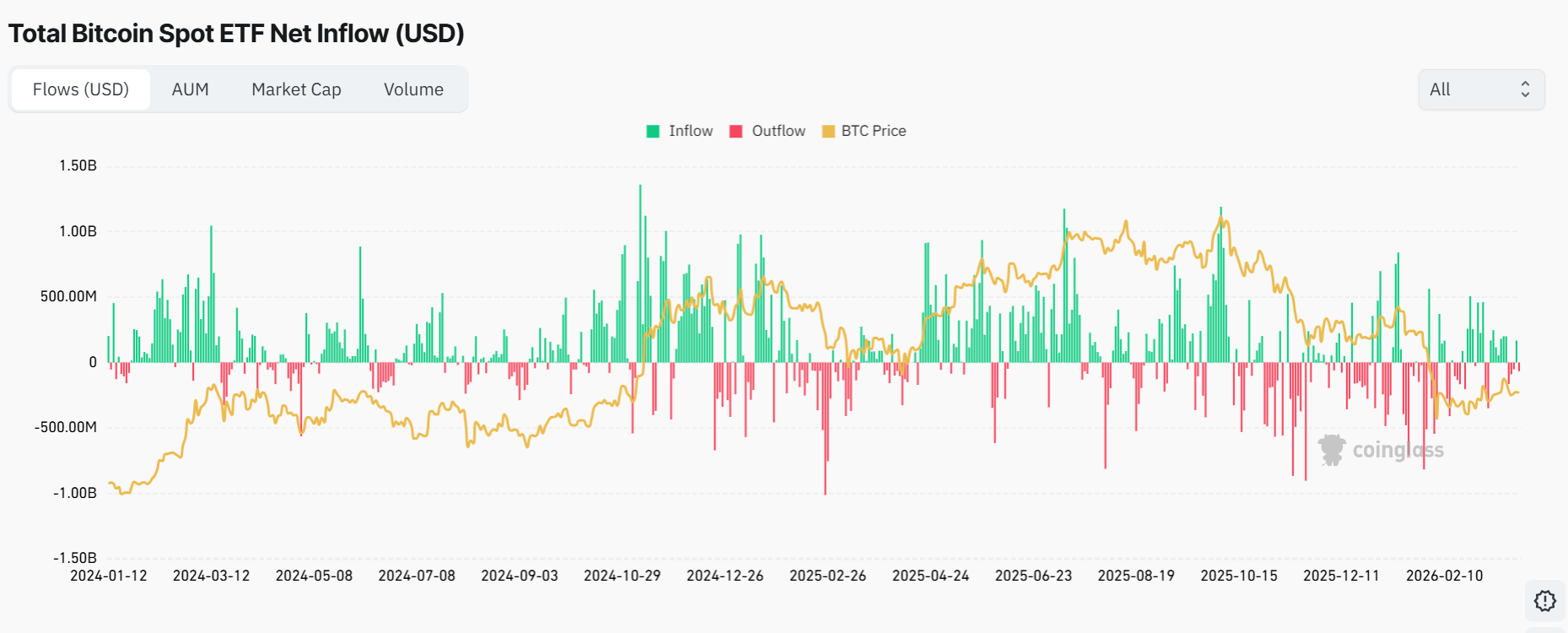
Total Bitcoin Spot ETF net inflows since launch January 2024, showing persistent buying through the 2026 price decline. (Source: Coinglass)
All of this happened while Bitcoin was down 40% from its recent highs and while the geopolitical backdrop, a US-Iran war, a stagflation PMI print, and a trapped Fed, was about as unfriendly as it gets.
What Balchunas Actually Said
Eric Balchunas, Bloomberg Intelligence’s senior ETF analyst and one of the most credible voices in the ETF world, called it in one phrase: “incredible fortitude.”
He has been tracking ETF flows long enough to know what normal investor behavior looks like during a 40% drawdown. It looks like selling. It looks like redemptions. It looks like what happened to gold ETFs roughly a decade ago when gold dropped sharply over six months. About one third of investors bailed from GLD and similar products. That is textbook behavior. That is what assets do when they fall 40%.
Bitcoin ETF holders did not do that. Only 6.6% of Bitcoin ETF assets exited during the same kind of drawdown. The other 93.4% sat through it. Some of them kept buying.
That asymmetry is not a small data point. It is a structural signal about who owns Bitcoin through ETFs and what their time horizon looks like.
The Gold Comparison Is the Whole Story
The gold parallel runs deeper than just the drawdown comparison. Gold ETFs suffered a roughly 40% drop over six months about a decade ago. A third of assets left. But gold ETFs later rebuilt and now hold roughly $160 billion. The selloff did not kill the product. It just looked bad for a while.
Bitcoin ETFs launched in January 2024 and spent their first year pulling in $23 billion. Then 2026 arrived with a war, a stagflation signal, and a price that went the wrong direction. The narrative shifted. Gold was the safe haven. Bitcoin was the problem asset.
But the flows in March tell a different story. The money that left in January and February came back. And it came back faster than most analysts expected, during a month when the macro environment gave investors every excuse not to.
Also worth noting: Morgan Stanley just filed paperwork for its own spot Bitcoin ETF, and Strategy dropped SEC filings authorizing another $42 billion in Bitcoin purchases. The institutional infrastructure around Bitcoin is expanding, not contracting, in the middle of the worst price environment in over a year.
What the Whale Accumulation Data Adds
The ETF inflow story does not exist in isolation. We wrote last month about 270,000 Bitcoin being removed from exchanges over 38 consecutive days while retail was in extreme fear. Exchange reserves hit seven-year lows. On-chain data showed the 1,000 to 10,000 BTC wallet cohort accumulating at a rate consistent with long-term positioning, not trading.
The ETF inflows are the same story in a different wrapper. Whether it is a whale wallet moving Bitcoin to cold storage or an institutional investor buying IBIT through their brokerage account, the behavior is identical. Someone with conviction and capital is absorbing supply while others sell.
Balchunas framed the ETF investors as “structurally different from crypto-native traders.” He is right. The ETF wrapper brought a different kind of buyer into Bitcoin. One with a longer time horizon, a portfolio allocation framework, and a financial adviser telling them not to panic sell.
That structural change is what the March inflows are actually measuring.
Where This Leaves Bitcoin
Bitcoin is at approximately $71,000 as of this writing. Down from $87,496 at the start of the year. The safe haven narrative briefly shifted to gold, which had its own extraordinary run before pulling back sharply last week.
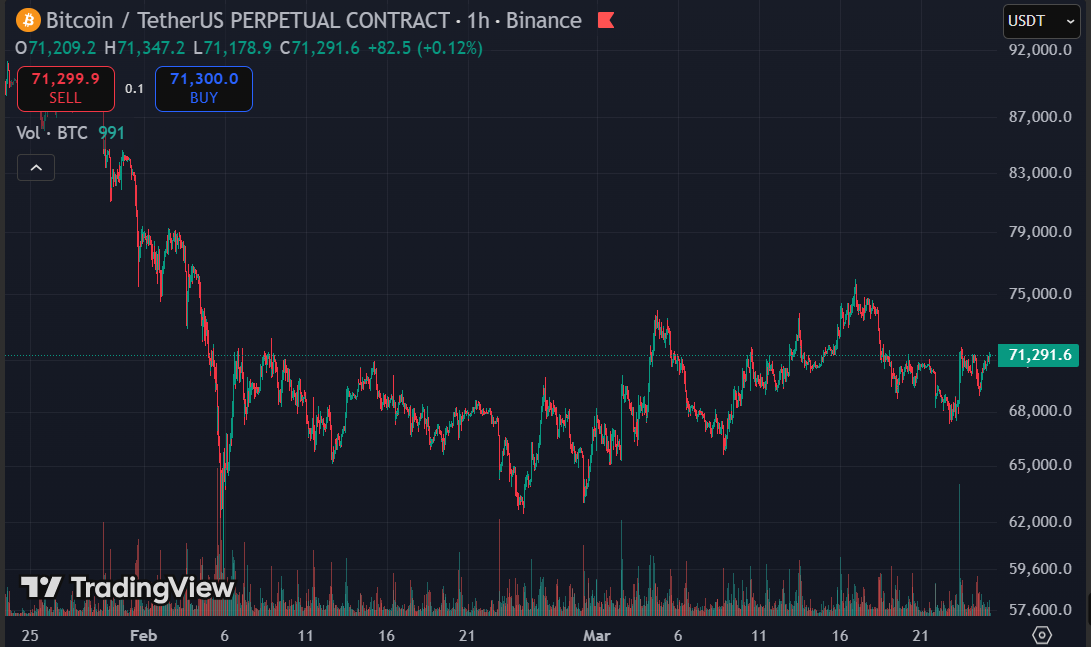
Bitcoin chart on March 25, 2026 (Price $71,291). (Source: TradingView)
The ETF data suggests the institutional floor under Bitcoin is firmer than the price action implies. $2.5 billion does not flow into an asset class in a single month from investors who have given up on it.
Balchunas put the conclusion plainly: “A selloff doesn’t mean the end. It just means it’s a selloff.”
Gold ETFs survived their 40% drawdown and rebuilt to $160 billion. Bitcoin ETFs are one good day away from erasing their entire 2026 outflow deficit. The comparison Balchunas keeps drawing is not accidental. He has seen this movie before. The asset class changes. The investor behavior does not.