
ETH is at $2,064. Down 57% from its August 2025 all-time high of $4,950. Underperforming Bitcoin for the third consecutive year. Spot Ethereum ETFs have seen $2.76 billion in net outflows over four months. The Fear and Greed index is in extreme fear territory.
None of that is the interesting part.
The interesting part is that while ETH bleeds, Ethereum’s network just hit 2 million daily active addresses, shattering the previous 2021 bull market peak of 1.7 million. Smart contract calls exceeded 40 million per day, a 60% increase over the prior record. $56 billion in total value locked sits on the network.
The price says Ethereum is losing. Everything else says it is winning. One of them is right. And the answer is more uncomfortable than either side wants to admit.
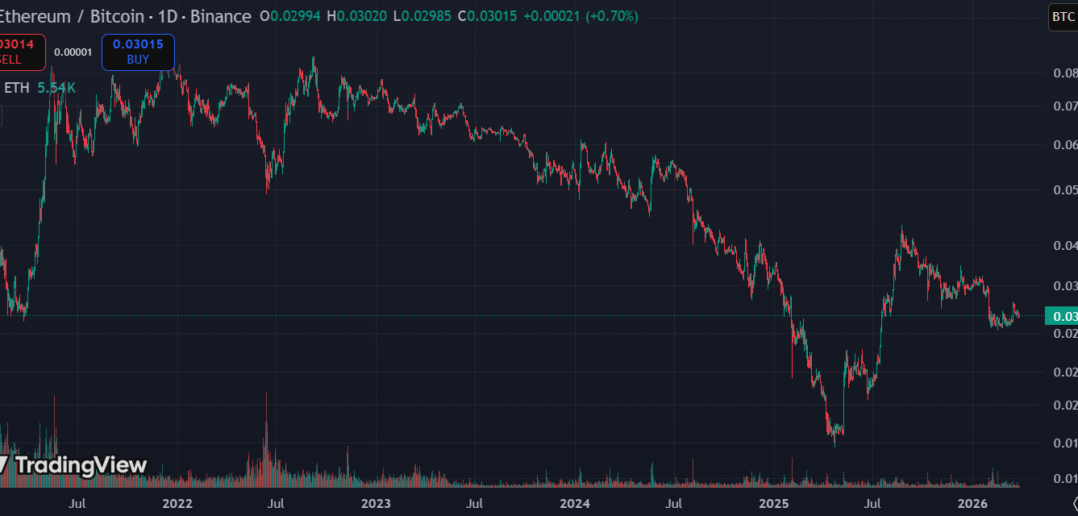
Ethereum underperforming Bitcoin for the third consecutive year (Source: TradingView)
The L2 Trap It Built for Itself
Ethereum’s scaling strategy was elegant in theory. Move transaction volume to Layer 2 networks, keep the base layer secure and decentralized, let the L2 ecosystem compete and innovate. Vitalik Buterin championed it. The developer community built it. It worked.
That is the problem.
146 active L2 networks now carry $38.2 billion in TVL. Gas costs on mainnet dropped 95% to roughly $0.01 per transaction. Daily ETH burn has collapsed to just 3.26 ETH. The mechanism introduced in the London hard fork of 2021 to make ETH deflationary is effectively broken. ETH supply is now growing, not shrinking. Ethereum built the most successful scaling ecosystem in crypto history and in doing so destroyed its own revenue model.
The L2s are not paying Ethereum enough rent. They post data to mainnet cheaply, capture transaction fees themselves, and build their own ecosystems that compete with Ethereum for users and developers. Base, built by Coinbase, processed more daily transactions than Ethereum mainnet last year. Arbitrum and Optimism have their own tokens, their own governance, their own identities. They are Ethereum’s children who moved out and stopped sending money home.
The upcoming Glamsterdam upgrade promises 10,000 transactions per second and another 78% reduction in gas fees. That will bring more users. It will also reduce ETH burn even further. Ethereum keeps solving the wrong problem.
The Identity Crisis Nobody Wants to Name
Ask ten Ethereum holders what Ethereum is for and you will get ten different answers.
It started as the world computer. A platform for decentralized applications that would replace corporate intermediaries. Then it became ultrasound money, a deflationary asset with superior monetary properties to Bitcoin. Then it became the settlement layer for a modular blockchain ecosystem. Now it is being pitched as the institutional tokenization platform for real-world assets.
Each pivot happened because the previous narrative stopped working. The world computer narrative collapsed when gas fees hit $200 and priced out actual users. The ultrasound money narrative collapsed when L2s killed the burn mechanism. The settlement layer narrative is currently being tested by the fact that ETH institutional treasury holdings stand at just 3.1% of total supply compared to Bitcoin’s 17%. Institutions are buying Bitcoin treasuries. They are not buying Ethereum treasuries at the same scale.
The Ethereum Foundation selling $10 million of ETH into a declining market did not help. We covered what that actually signals about the foundation’s own confidence in the asset — and the picture is not reassuring. When the organization responsible for Ethereum’s development is a net seller, the ultrasound money narrative becomes harder to defend.
The Solana Reality
Solana is not supposed to be winning. It crashed 96% in the FTX collapse. It was declared dead by serious people multiple times. Its founder was closely associated with Sam Bankman-Fried.
And yet.
Solana DEX volume hit $95.5 billion in February versus Ethereum’s $56.5 billion. Solana’s developer growth rate is running at 42% year on year. The Solana Foundation launched an institutional developer platform backed by Mastercard, Western Union, and Worldpay. The meme coin cycle, the consumer app cycle, and the AI agent payment cycle all ran primarily on Solana, not Ethereum.
Ethereum has the larger absolute developer base. The question is whether that lead is structural or historical. The developers who built on Ethereum in 2017 and 2018 did so because there was no alternative. The developers choosing in 2026 have options. And an increasing number of them are choosing something faster, cheaper, and simpler.
Ethereum’s response has been to build more L2s. Which brings us back to the L2 trap.
The Uncomfortable Flip
Here is the part the bears do not want to acknowledge.
Ethereum’s $56 billion TVL dwarfs the combined TVL of Solana, Bitcoin, and BNB Chain. The combined TVL of the next three chains totals approximately $22 billion. Ethereum holds more than double that on its own. JPMorgan, Citi, Deutsche Bank, and BlackRock are not building on Solana. They are building on Ethereum. 68% of the real-world asset tokenization market sits on Ethereum. Over 32 million ETH is staked, securing more than $105 billion in economic value across over one million active validators. BlackRock’s launch of a staked Ethereum ETF, the first of its kind offering yield inside a regulated wrapper, is the clearest signal yet of where institutional money sees Ethereum’s long-term role.
Ethereum did not lose the institutional capital markets. It won them. What it lost is everything else.
What Ethereum Actually Lost
The retail battle. Solana owns meme coins, consumer apps, and the attention economy of crypto.
The peer-to-peer transaction battle. Its own L2s do this now, without paying meaningful fees to mainnet.
The monetary policy battle. ETH is inflationary again. The ultrasound money narrative is dead until burn rates recover.
The narrative battle. Nobody can explain in one sentence what Ethereum is for anymore. Bitcoin is digital gold. Solana is fast and cheap. Ethereum is the settlement layer for L2s that also hosts DeFi and RWA tokenization and has staking and used to be deflationary but now is not.
What Ethereum has not lost is the institutional infrastructure battle. $56 billion in TVL does not lie. The world’s largest banks are not going to migrate their tokenization infrastructure to Solana because Solana is faster. They are going to stay where the security model is proven, the developer talent is deepest, and the regulatory familiarity is highest.
The price says Ethereum is losing. The TVL says it is the foundation of institutional DeFi. The L2 ecosystem says it solved scaling and broke its own economics doing it.
Sometimes an asset becomes something different from what it was designed to be. Bitcoin was supposed to be peer-to-peer cash. It became digital gold. Ethereum was supposed to be the world computer. It may be becoming the institutional settlement layer whether it wants to or not.
The question is whether that is enough to justify being the number two cryptocurrency. And whether a price that is down 57% from its all-time high with inflationary supply and collapsing fee revenue is the market already answering that question.
Ethereum already lost the battles that made people excited about it. The battle it is currently winning is one that hedge funds and central banks care about, not the people who put Ethereum stickers on their laptops in 2017.
Whether that is a loss or a transformation depends on what you thought Ethereum was supposed to be.