
You bought Bitcoin in 2021. You moved it to a hardware wallet for safekeeping. You moved it back to Coinbase in 2025 and sold it. Straightforward enough.
Then your Form 1099-DA arrived.
Coinbase reported your 2025 sale to the IRS showing the full proceeds with zero cost basis. To the IRS matching system, it looks like you acquired that Bitcoin for nothing and sold it for everything. You are staring at a tax bill calculated on gains you never actually made.
This is not a glitch. It is not fraud. It is exactly how Form 1099-DA was designed to work in its first year of reporting, and it is going to create an enormous number of incorrect tax bills for people who held crypto across multiple wallets or exchanges over the past several years.
Here is what happened, why it happened, and what you need to do before the IRS sends you a CP2000 notice.
What Form 1099-DA Actually Is
Starting with the 2025 tax year, US crypto exchanges including Coinbase, Kraken, Gemini, and Robinhood are required to issue Form 1099-DA to customers and to the IRS. DA stands for Digital Assets. It works like other 1099 forms, reporting your transactions directly to the IRS so they can cross-reference what you report on your tax return. (Coinbase, 2025)
The critical detail for 2025 reporting is this: for the first year of 1099-DA reporting, brokers are required to report gross proceeds only, not cost basis. Capital gains taxes are calculated by subtracting cost basis from sale proceeds. Without the basis figure in the form, the IRS sees only the gross proceeds.
That means if you sold one Bitcoin for $70,000 in 2025, Coinbase reports $70,000 to the IRS. If Coinbase does not know what you originally paid for that Bitcoin because you bought it on another exchange or stored it in a personal wallet before bringing it back to Coinbase, your form shows $70,000 in proceeds and $0 or unknown in cost basis.
The IRS then assumes your gain is $70,000. Your actual gain might be $5,000.
Why Coinbase Does Not Know Your Cost Basis
Every time you transferred crypto into Coinbase from another exchange or from a hardware wallet, Coinbase lost track of what you originally paid. Coinbase is not required to track cost basis for any cryptocurrency purchased before January 1, 2026.
This affects an enormous number of people. Anyone who:
Bought Bitcoin on one exchange and moved it to Coinbase to sell. Moved Bitcoin to a Ledger, Trezor, or other hardware wallet at any point and later returned it to Coinbase. Used multiple exchanges across different years. Received Bitcoin as payment, mining rewards, or through any method outside Coinbase itself.
In all of these cases, Coinbase has no record of the original purchase price. A sale of Bitcoin that you bought in 2018 on Coinbase, moved to a hardware wallet, and later deposited back to Coinbase for sale will show proceeds on your 1099-DA but no cost basis. To the IRS matching system, this looks like you sold an asset for the full proceeds amount with zero basis, generating a much larger taxable gain than you actually owe.
The CP2000 Problem
The IRS receives the same 1099-DA that you do. When they run their matching program and compare what Coinbase reported to what you reported on your return, any discrepancy triggers a CP2000 notice. This is not an audit. It is an automated proposal from the IRS saying they believe you underreported income and here is what you owe.
The IRS has previously used information from 1099 forms to send CP2000 warning letters to Coinbase users. Discrepancies between Form 1099 and your tax return can increase the risk of a cryptocurrency tax audit.
Even if your 1099-DA is wrong, you still have to report it. You cannot ignore a form the IRS has already received. What you can do is correct it.
What You Need to Do Right Now
Step one is to not file your taxes using only the numbers on your 1099-DA. That form is incomplete by design in 2025. It shows what you sold. It does not show what you paid.
Step two is to reconstruct your complete transaction history. Every exchange you used. Every wallet you held Bitcoin in. Every transfer between them. The purchase date and price for every lot you acquired. This sounds painful and for many people it genuinely is, especially if you have been active in crypto since 2017, 2018, or 2020 and used multiple platforms.
Step three is to use crypto tax software to reconcile everything automatically. This is the practical solution for anyone with more than a handful of transactions.
Koinly connects to every major exchange and wallet, imports your full transaction history, calculates your actual cost basis for each lot, and generates the correct figures for your tax return including Form 8949 which is where capital gains and losses are actually reported to the IRS. It handles the exact problem the Reddit comment described: years of buys on one platform, transfers to hardware wallets, and final sales on Coinbase all reconciled into one accurate tax report.
CoinLedger does the same thing and also specifically addresses the 1099-DA problem by reconciling the form Coinbase sent against your actual transaction history so you can see exactly where the discrepancy is and what your corrected numbers should be.
Both tools are significantly cheaper than hiring a CPA to manually reconstruct years of transaction history, and both generate output that is directly usable when filing.
The Accounting Method Matters Too
When you sell Bitcoin, the IRS requires you to specify which lot you are selling using a cost basis accounting method. The most common is FIFO, first in first out, which means the oldest Bitcoin you own is treated as the first sold. LIFO, last in first out, treats the newest as sold first. HIFO, highest in first out, treats the most expensive lot as sold first and typically minimizes your taxable gain.
Coinbase lets you select your cost basis accounting method for historical and future transactions, but once you confirm your historical method it cannot be changed. Choose carefully and choose once. If you are unsure which method is most advantageous for your situation, this is worth a conversation with a tax professional before you lock it in.
Starting January 2026 It Gets Better
The good news is the 1099-DA reporting framework improves significantly going forward. Beginning tax year 2026, Form 1099-DA will also include cost basis information for assets that are considered covered, meaning they were purchased and held within the same broker account from January 1, 2026 onward.
For assets you acquired before 2026 or moved between platforms, cost basis reporting remains your responsibility. The 2025 tax year is the worst version of this problem. It does not go away entirely but it becomes more manageable for new purchases from 2026 forward.
The Specific Scenario From the Reddit Thread
The person who commented on this had four years of Bitcoin buys, moved everything to a personal wallet, and then returned it all to Coinbase. Coinbase is reporting the entire amount as a gain with no cost basis because it has no record of the original purchases made four years ago.
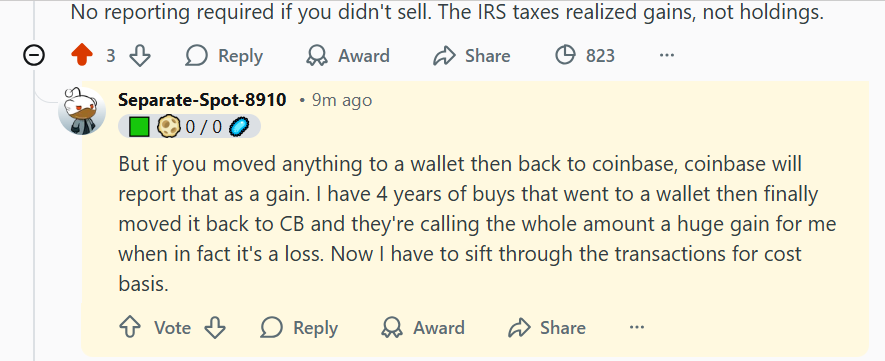
The fix is straightforward in principle and tedious in practice. They need to pull transaction records from every platform they used, document the purchase price and date for every acquisition, and reconcile that history against the Coinbase 1099-DA to arrive at the actual gain or loss.
A tool like Koinly or CoinLedger automates most of this if the original exchange accounts are still accessible. If records are missing or accounts have been closed, reconstructing the history manually using bank statements, email confirmations, and blockchain transaction records is the fallback.
The key point is that the work is worth doing. Paying taxes on $70,000 in gains when your actual gain was $5,000 is not a legal obligation. It is a documentation problem. The IRS requires you to prove your cost basis. The burden of proof is on you, not on Coinbase.
Bottom Line
Form 1099-DA is new, incomplete by design in its first year, and is going to generate incorrect tax bills for a significant number of crypto holders. The solution is not to ignore it or to accept the numbers it shows.
If you sold crypto on Coinbase in 2025 and ever moved that crypto between wallets or exchanges, do not file until you have reconciled your complete transaction history. The cost of getting it wrong is a CP2000 notice and a tax bill calculated on gains you never made.
Note: This article provides general information only and is not tax or legal advice. If you are facing a significant discrepancy on your 1099-DA, consult a qualified tax professional familiar with cryptocurrency reporting.