
The math is not complicated. It costs the average publicly listed Bitcoin miner $79,995 to produce one coin. Bitcoin is trading around $70,000. That is roughly a $10,000 loss on every coin mined.
This has been the reality for most of 2026. And the industry’s response is not to wait it out. It is to exit.
A new report from CoinShares, published this week, puts numbers to what has been visible for months. Bitcoin mining as it existed for the past decade is being replaced by something else entirely. The companies that built their identities around securing the Bitcoin network are selling their coins, taking on billions in debt, and converting their data centers into AI infrastructure. The transformation is accelerating and the implications for Bitcoin’s security run deeper than most people realize.
How Bad the Economics Got
To understand why miners are leaving, you need to understand what the past eighteen months did to the industry.
The April 2024 halving cut block rewards from 6.25 BTC to 3.125 BTC overnight. Revenue halved. Costs did not. Electricity contracts, hardware debt, facility leases, none of it adjusted with the reward. Miners who had built their models around the higher subsidy were suddenly underwater before a single difficulty adjustment ran.
Then Bitcoin peaked at $125,000 in October 2025 and collapsed to $86,000 by December, a 31% drop in two months. Hashrate stayed near record levels as new machines came online despite the price decline. More competition for a smaller reward at lower prices. Hashprice, the daily revenue per unit of computing power, dropped from $36 to $38 per petahash per second in late 2025 to $28 to $30 in early 2026, a post-halving low. CoinShares Head of Research James Butterfill called it the most challenging quarter for miners since the April 2024 halving, according to a new report published this week.
The weighted average cash cost of $79,995 per coin is the result of all of this compounding at once. Between 15% and 20% of the global mining fleet is currently operating at negative margins. Operators running older hardware or paying above $0.05 per kilowatt-hour for electricity are most exposed.
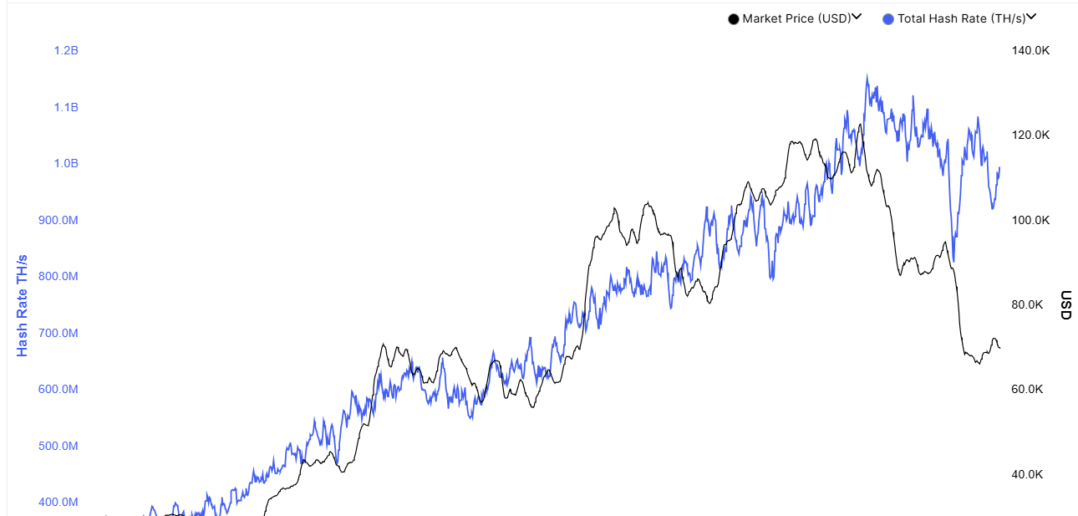
Bitcoin hashrate continued climbing even as price collapsed from $125,000 to $70,000 in late 2025, compressing miner margins to record lows. Source: Blockchain.com
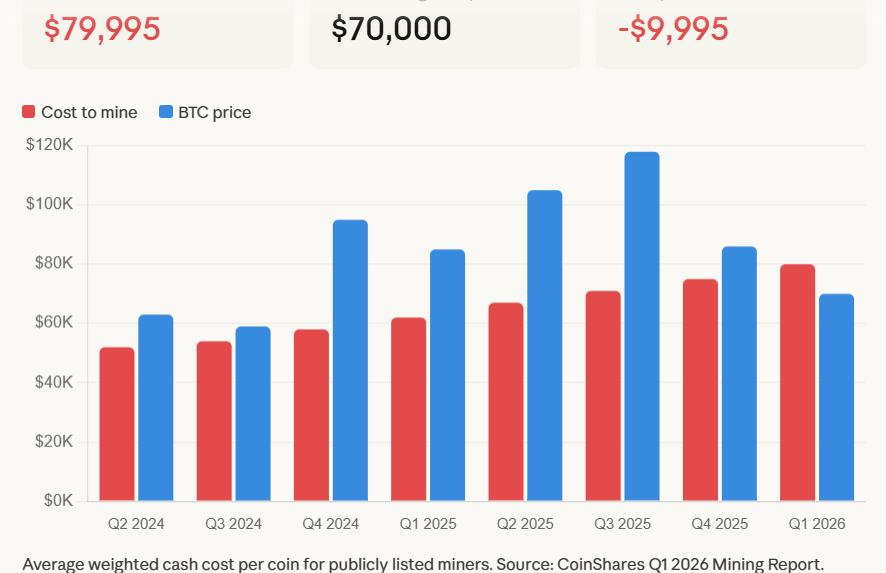
Average cost to mine one Bitcoin reached $79,995 in Q1 2026 while price averaged $70,000, leaving miners with a $9,995 loss per coin.
For a deeper look at how difficulty adjustments have responded to this pressure, see our recent breakdown of Bitcoin’s mining difficulty drop in March 2026.
The Pivot Nobody Is Framing Correctly
Every outlet is reporting the AI pivot as a strategic choice. It is not. It is a survival response dressed up in forward-looking language.
Bitcoin mining infrastructure, high-density power, precision cooling, purpose-built compute facilities, maps almost perfectly onto what AI data centers need. Miners figured this out faster than anyone expected. More than $70 billion in cumulative AI and high-performance computing contracts have now been announced across publicly listed miners, according to the CoinShares report.
The individual deals are staggering. CoreWeave’s expanded agreement with Core Scientific is worth $10.2 billion over twelve years. TeraWulf has $12.8 billion in contracted HPC revenue. Hut 8 signed a $7 billion fifteen-year lease for AI infrastructure at its River Bend campus. These are not side projects. These are the new core business.
CoinShares estimates that roughly 30% of listed miner revenue already comes from AI and HPC activities. Butterfill projects that figure could reach 70% by the end of 2026. Read that again. By December, the companies that call themselves Bitcoin miners may derive less than a third of their revenue from mining Bitcoin.
How They Are Funding It
The AI pivot requires capital that most miners do not have. They are getting it two ways and both have consequences for Bitcoin.
First, debt. IREN now carries $3.7 billion in convertible notes. TeraWulf holds $5.7 billion in aggregate debt. Cipher Digital issued $1.7 billion in senior secured notes in November, causing quarterly interest expenses to jump from $3.2 million to $33.4 million in a single quarter. These are companies that were built on the premise of accumulating Bitcoin. They are now accumulating leverage instead.
Second, Bitcoin sales. Publicly listed miners have collectively sold more than 15,000 BTC from their peak treasury holdings. Core Scientific liquidated approximately 1,900 BTC worth $175 million in January and is planning to sell substantially all remaining holdings in Q1 2026. Bitdeer reduced its treasury to zero in February. Riot Platforms sold 1,818 BTC worth $162 million in December. Bitfarms CEO Ben Gagnon has been explicit: “We are no longer a Bitcoin company.”
Even MARA, the largest public Bitcoin holder at 53,822 BTC, quietly expanded its policy in its March 10-K filing to authorize sales from its entire balance sheet reserve. The loan-to-value ratio on its $350 million Bitcoin-backed credit facility climbed to 87% as prices fell toward $68,000. That is not a comfortable position.
The Market Has Already Priced the Split
Wall Street is not waiting for this transition to play out. It has already decided which side wins.
Miners with secured AI and HPC contracts now trade at 12.3 times next-twelve-month sales. Pure-play Bitcoin miners trade at 5.9 times. The market is paying more than double for AI exposure in a mining stock. That valuation gap is its own incentive. Every miner watching their peers trade at 12x while they trade at 6x has a financial reason to announce an AI deal.
The bifurcation is visible in which companies are accelerating and which are holding. IREN, TeraWulf, Core Scientific, Cipher, and Hut 8 are moving furthest toward data center infrastructure. MARA is the notable holdout, continuing to prioritize Bitcoin mining while most others pivot. It is an increasingly lonely position.
What This Does to Bitcoin
Here is the part of this story that most coverage is missing.
The miners selling Bitcoin to fund AI buildouts are the same companies whose mining operations secure the Bitcoin network. Every BTC sold to finance an HPC contract is a coin that was supposed to stay in treasury, supporting the long-term belief that these companies were aligned with Bitcoin’s appreciation. That alignment is breaking down.
More consequentially, if significant hashrate migrates permanently from Bitcoin mining to AI infrastructure, Bitcoin’s security budget faces a structural problem. The network’s security depends on miners having a financial incentive to keep running. If the better business is hosting Nvidia GPUs instead of mining rigs, that incentive weakens.
CoinShares projects global hashrate could reach 1.8 zetahashes by end of 2026, but that projection assumes Bitcoin recovers toward $100,000. If it stays at $70,000 or below, the firm expects additional miner capitulation and continued acceleration of the AI pivot. The hashrate recovery projection and the AI pivot are actually in tension with each other. You cannot have both if prices stay here.
Next-generation hardware could change the calculus. Bitmain’s S23 series and Bitdeer’s SEALMINER A3, both operating below 10 joules per terahash, are expected at scale through the first half of 2026 and would roughly halve energy costs compared to current mid-generation fleets. But deploying new mining hardware requires capital, and that capital is currently going toward AI contracts instead.
One Variable
The entire question of whether this is a temporary response or a permanent structural shift comes down to Bitcoin’s price.
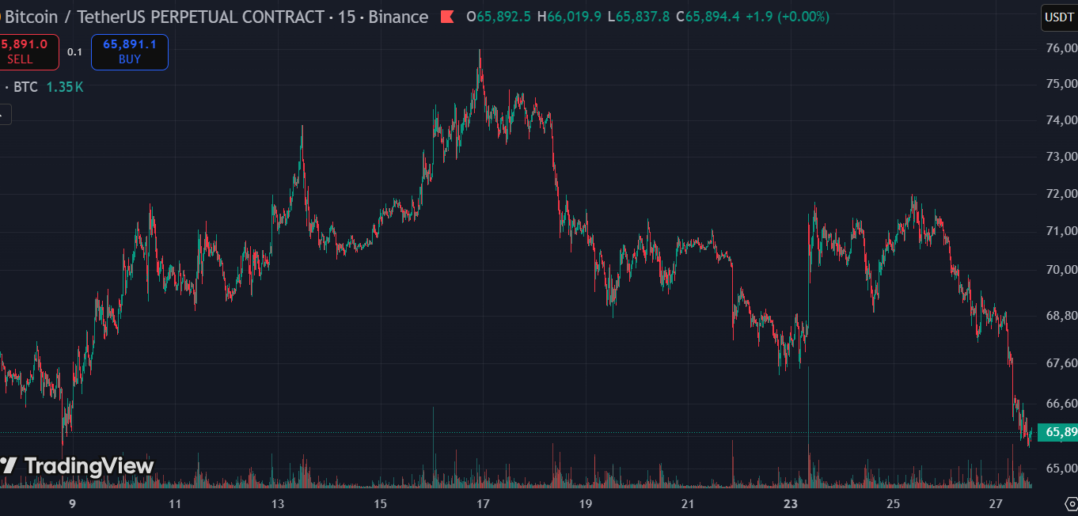
Bitcoin chart on March 27, 2026. (Source: TradingView)
At $100,000, mining margins recover, hashprice rises toward $37 per petahash per second, and the AI pivot slows. Companies that built AI infrastructure as a bridge can redirect attention back to mining with better economics. At $70,000 or below, the pivot accelerates. More coins get sold. More data centers get converted. More companies quietly stop calling themselves Bitcoin miners even if they keep a few rigs running.
The Bitcoin mining industry entered this cycle securing the network and accumulating coins. It is exiting as a group of companies that build AI data centers and sell Bitcoin to fund them.
Whether that is a rational response to a temporary price dislocation or the beginning of something more permanent is the open question. The difficulty adjustment runs on schedule regardless. The blocks keep coming. But the companies keeping them coming are changing what they are, and the transition is moving faster than most people outside the industry have noticed.