
From mid-October through late February, institutional investors pulled roughly $9 billion out of spot Bitcoin ETFs. Not in a panic. Steadily, consistently, day after day. Bitcoin was falling and nobody was buying the dip. Bloomberg ETF analyst James Seyffart said what everyone was thinking: “It was surprising to me that there was basically no dip buying when bitcoin was a falling knife to start the year.”
Then Iran struck the UAE. Dubai closed its stock exchange. Bitcoin kept trading.
And the money started coming back.
The Numbers
February 24 — the first full trading day after the strikes — US spot Bitcoin ETFs recorded $257.7 million in net inflows. The streak of daily outflows stretching back to late January was over. The following day, $506.5 million came in. The strongest single session in three weeks. Every one of the 11 active spot Bitcoin ETFs saw net buying or zero flow. Not one recorded a redemption. Even Grayscale’s GBTC, which has bled roughly $25.9 billion in cumulative outflows since converting to an ETF, had a rare positive day.
Since February 24, investors have added roughly $1.7 billion back in.
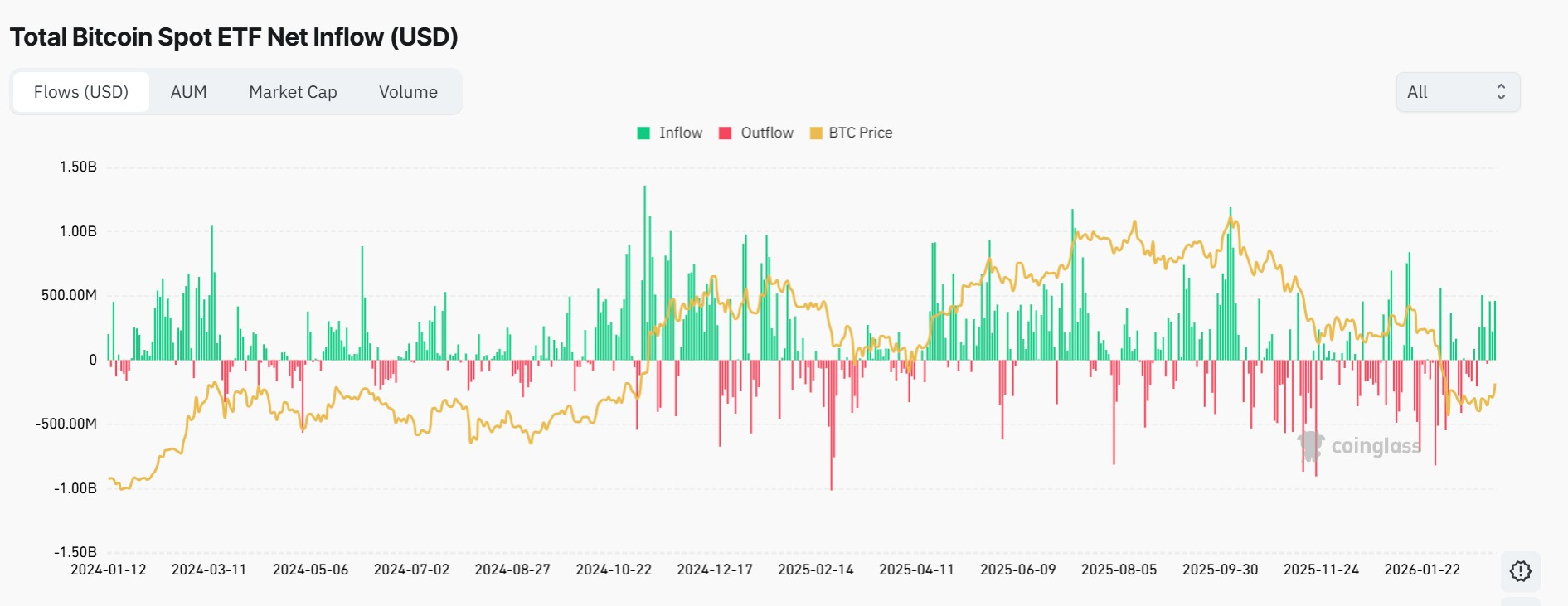
Bitcoin Spot ETF net flows — nine billion out from October through February, then the reversal.
Source: Coinglass
BlackRock Led It
IBIT pulled in $297.4 million on February 25 alone. Nearly 60% of that day’s total. The fund now holds close to 765,000 BTC valued at over $50 billion. Bitcoin is down 16% this year and IBIT is still net positive for 2026.
Nate Geraci, president of the ETF Store, made the point clearly. BlackRock has hundreds of ETFs. Many of them have better recent performance than IBIT. They are not pushing this product because it’s their best performer right now. “I see it more as the firm doubling down on its conviction that bitcoin belongs in diversified portfolios,” he said.
That conviction is showing up in the flows.
Not a Hedge. A Bet.
The analysts tracking this data are clear on what these flows represent. Not basis trades. Not market-neutral hedging. Outright directional bets. Institutional money that sat on the sidelines while Bitcoin quietly fell started moving when the world got visibly unstable.
Dubai closed its stock exchange when the missiles hit. Millions of investors couldn’t access their own money for 48 hours. Bitcoin processed every transaction without interruption. The institutions buying ETFs through that same window weren’t betting on the price going up. They were allocating to an asset that no government can close, no crisis can reach, and no emergency decree can touch.
That’s not a presentation argument anymore. It’s a capital allocation decision. And right now it looks like $1.7 billion worth of it.
The Sequence
Nine billion dollars left while markets were calm and Bitcoin was declining. A missile hits a major financial hub, a stock exchange closes, oil surges — and $1.7 billion comes back in eight days.
Months of falling prices didn’t move them. One closed stock exchange did.
Sources: