
$14.16 billion in Bitcoin options contracts set to expire Friday at 08:00 UTC on major exchanges like Deribit. Nearly 40% of all open interest on the world’s largest crypto derivatives exchange wiped out in a single settlement window. Max pain sat at $75,000. Bitcoin was trading at $66,000. The gap between where Bitcoin was and where the options market theoretically wanted it to be tells you everything about where sentiment is right now.
Then David Sacks announced he was leaving his role as White House AI and crypto czar.
Two pieces of bad news before lunch. Welcome to Friday.
What the Options Expiry Actually Means
The max pain theory is simple in concept and endlessly debated in practice. When a large number of options contracts expire, the price that causes the most damage to the most option buyers is the point where institutional sellers want the market to settle. For this expiry, that point was $75,000.
Bitcoin never got close. It spent the week sliding from $71,000 toward $66,000, finishing the expiry window roughly $9,000 below max pain.
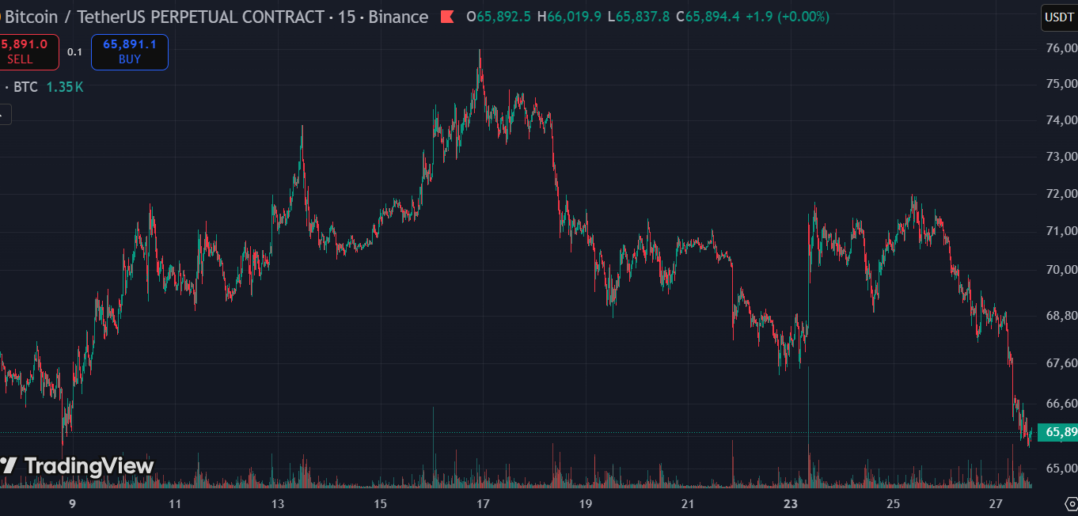
Bitcoin falls to around $66k after $14.6 billion in options set to expire, triggering short-term market volatility. Source: TradingView
What that means going forward is the structural cushion is gone. The hedging flows that had been acting like a magnet, nudging Bitcoin higher while capping gains, will now fade. Once the contracts roll off, the mechanical buying and selling tied to hedging recedes, leaving Bitcoin more exposed to external catalysts. And those catalysts are not friendly right now.
The Crypto Fear and Greed Index registered 13 on Friday, firmly entrenched in extreme fear territory. Bitcoin has repeatedly failed to sustain levels above $75,000 since regional tensions escalated nearly a month ago. The cryptocurrency remains down approximately 50% from its late-2025 all-time high near $126,000.
The next significant catalyst is not a Fed meeting or an ETF announcement. It is Trump’s extended Iran ceasefire deadline in early April. If that breaks badly, the structural buyers who have been absorbing selling pressure are the same institutional players Wintermute’s Jasper De Maere described as present but ready to exit rapidly if the weekend delivers an adverse outcome.
The options expiry did not cause today’s price action. It removed the mechanism that was softening it.
David Sacks Used Up His 130 Days
The timing was unfortunate but not surprising. David Sacks told Bloomberg on Thursday that he had used up his 130 days as a special government employee and is joining the President’s Council of Advisers on Science and Technology.
The departure closes a tenure that reshaped the federal government’s posture toward digital assets but left its biggest deliverables unfinished. Sacks drove the passage of the GENIUS Act on stablecoins and championed the creation of a strategic Bitcoin reserve seeded with government-seized BTC.
The GENIUS Act passed. The Strategic Bitcoin Reserve exists on paper. Everything else is still in progress.
The CLARITY Act, the market structure bill that would settle how the SEC and CFTC divide oversight of crypto, has no clear timeline for Senate passage. Senator Bernie Moreno has warned that if the bill does not reach the Senate floor by May, it risks going dark until after the midterms. Coin Center executive director Peter Van Valkenburgh put it more bluntly, warning that relying on short-term friendly discretion from the current administration instead of durable law would be a strategic mistake the industry may not recover from.
That warning lands differently now that the person most responsible for pushing the administration’s crypto agenda inside the White House has moved on.
What Sacks Actually Built in 130 Days
It is worth giving credit where it is due before writing the obituary.
When Sacks took the role in January 2025, the US government’s official position on Bitcoin was hostile. The SEC under Gary Gensler had spent years suing crypto companies. Banking regulators were restricting access for crypto firms. The previous administration treated the industry as a source of consumer fraud and nothing more.
During his time in the White House, Sacks played a central role in shaping the Trump administration’s crypto agenda, including efforts to pass market structure and stablecoin legislation and support for a US strategic Bitcoin reserve. He also pushed for clearer digital asset rules.
The Bitcoin reserve, even in its current limited form, represents a fundamental shift in how the US government thinks about Bitcoin as an asset. No previous administration had ever suggested the federal government should hold Bitcoin as a strategic reserve. That idea went from fringe to official policy in 130 days.
The GENIUS Act, which created the first federal licensing and reserve framework for stablecoins, is now law. The Resolv USR exploit we covered earlier this week, where an attacker minted $80 million in unbacked tokens and walked out with $25 million, happened in a DeFi protocol that fell outside the GENIUS Act’s definition. The law has gaps. But it exists, which is more than could be said 14 months ago.
The Problem Nobody Wants to Say Out Loud
The bigger issue with Sacks leaving is not the policy agenda. It is the vacuum.
One early proposal to create a permanent White House crypto council of industry leaders never materialized, with the administration instead opting for periodic summits and an internal digital-assets working group after industry infighting complicated the plan.
The industry spent a year and a half arguing about who should have access to the White House and which companies deserved a seat at the policy table. While that argument was happening, the window for passing legislation was narrowing.
Sacks is moving to PCAST, the President’s Council of Advisors on Science and Technology. The council includes Jensen Huang, Mark Zuckerberg, Marc Andreessen, Larry Ellison, and Fred Ehrsam. The only dedicated crypto voice in that group is Ehrsam, the Coinbase co-founder. The rest are AI, semiconductor, and enterprise software executives with different priorities.
Sacks will continue influencing technology policy. Whether he continues fighting specifically for the CLARITY Act from a broader advisory role is a different question.
Where This Leaves Bitcoin
Bitcoin at $66,000 is not a crisis. It is a price. It was $70,000 when Trump won the election in November 2024. It hit $126,000 in late 2025. It is now back below election night levels with an Iran war, a hawkish Fed, and no clear legislative timeline for the regulatory clarity the industry has been waiting for.
The institutional money has not left. Bitcoin ETFs attracted $2.5 billion in net capital over the past month. BlackRock’s Bitcoin ETF ranked among the top 2% of all ETFs by year-to-date inflows. The buyers are there. They are just not in a hurry right now.
The options expiry removed the structural support. The Sacks departure removed the legislative advocate. The Iran deadline in April is the next catalyst that could move this market in either direction.
The thing that does not change is the underlying question. Bitcoin was built for exactly the environment we are currently in. Inflation above target. A central bank that cannot cut rates. Geopolitical instability reshaping how capital moves across borders. A government running deficits with no credible plan to stop.
Those conditions do not expire on Deribit at 8:00 AM UTC.