
Arthur Hayes broke a three month silence on Hyperliquid this week. On-chain data flagged by Lookonchain confirmed he received 26,022 HYPE tokens worth approximately $1.1 million from market maker Flowdesk, bringing his total position to 247,334 HYPE valued at $10.44 million. He is sitting on unrealized gains of roughly $2.23 million. His public price target remains $150 by August 2026, a 266% increase from current levels.
The timing of the accumulation tells you something. Hayes did not buy three months ago when the story was simpler. He bought this week, when the story got complicated.
What Changed in Three Months
When Hayes last accumulated HYPE, Hyperliquid was posting extraordinary numbers. The protocol generated $14 million in fees in a single week in March 2026, a 56% jump week over week. Monthly fees for March exceeded $53 million, putting the protocol on track for a $640 million annualized fee run rate. JPMorgan published a research note specifically highlighting Hyperliquid’s oil trading surge, noting that Iran war volatility pushed traders onto decentralized exchanges where markets never close. When JPMorgan writes a research report about a DEX, something has shifted.
Then the numbers started moving the other way.
Total DEX spot volume fell 23.9% to $212 billion in March, the lowest monthly figure since October 2024. Monthly perpetual DEX volumes dropped to $699 billion in March, down from a peak of $1.369 trillion in October 2025. That is nearly a 50% decline in five months. Hyperliquid still leads the perp segment. It captured 29.7% of the TradFi perpetual swaps market in Q1 according to BitMEX Research, with 953% quarterly volume growth in that category. But the broader DEX market is contracting around it.
Hyperliquid’s fee buyback model is elegant when volumes are high. The protocol returns 97% of trading fees to buy back and burn HYPE from the open market, creating a deflationary loop that ties token value directly to platform activity. When platform activity halves, the engine slows.
Hayes bought into that dynamic this week. Not despite it. Into it.
The Real Bet
Hayes is not buying the current Hyperliquid. He is buying what four asset managers are racing to deliver to the institutional market.
Bitwise filed an amended S-1 with the SEC on April 10, adding the BHYP ticker and a 0.67% management fee. Bloomberg senior ETF analyst Eric Balchunas noted publicly that adding a ticker and fee typically signals a launch is imminent. The product would trade on NYSE Arca, include a staking component retaining roughly 85% of staking rewards, and use Anchorage Digital as custodian.
Grayscale filed an S-1 for the GHYP ETF on Nasdaq in late March with Coinbase Custody. 21Shares filed in October 2025. VanEck has confirmed plans for a staking ETF under the VHYP ticker. Four institutional issuers are in a race to be first. None of them file amended registrations with tickers and fees unless they believe approval is close.
This is the Bitcoin ETF playbook replaying with a DeFi-native token. When spot Bitcoin ETFs launched in January 2024 they attracted over $56 billion in inflows in the first year. Hyperliquid has a smaller float and a more concentrated tokenomics structure. Approximately 299 million HYPE in circulating supply against a fixed maximum of one billion. The deflationary buyback mechanism means ETF inflows would compete for tokens that are simultaneously being removed from circulation.
Hayes has been explicit about his thesis. He told CoinDesk in March that Hyperliquid generates real trading revenue rather than incentive-inflated volume. He evaluated it using the ratio of trading volume to open interest, which he called the lowest among major perp DEXs, and said it offers the tightest execution for large orders in the $100,000 to $10 million range. His fund Maelstrom holds it as its largest position.
The only thing we’re buying right now is $HYPE
— Arthur Hayes (@CryptoHayes) April 8, 2026
The $150 price target only makes sense if the ETF catalyst lands. Without institutional inflows the deflationary model is working against falling volumes. With them, it becomes a supply squeeze.
The Part That Does Not Get Said
Hayes has a $10.44 million position in the thing he is recommending publicly. That is not a reason to dismiss the thesis. He has been transparent about his holdings and the reasoning behind them. But it is a reason to separate the argument from the messenger and evaluate both independently.
The independent case for HYPE rests on three legs. Real revenue, not inflated. TradFi adoption expanding the addressable market beyond crypto natives. ETF approvals bringing institutional capital into a scarce deflationary asset.
The case against rests on two. Volume compression that slows the buyback engine at exactly the moment institutional attention peaks. And the regulatory uncertainty that still surrounds every DeFi-native token ETF filing. The SEC has approved spot Bitcoin and Ethereum ETFs. It has not approved anything built primarily on a protocol that did not exist three years ago.
Hayes is betting all three bullish legs hold before the two bearish ones collapse the floor.
His three month silence followed by a $1.1 million purchase the same week Bitwise added a ticker and fee to its filing is not a coincidence. He watched the ETF race accelerate, watched the volume data compress, and decided the institutional catalyst arrives before the volume decline becomes structural.
Whether he is right determines whether $40 HYPE becomes $150 or $29.
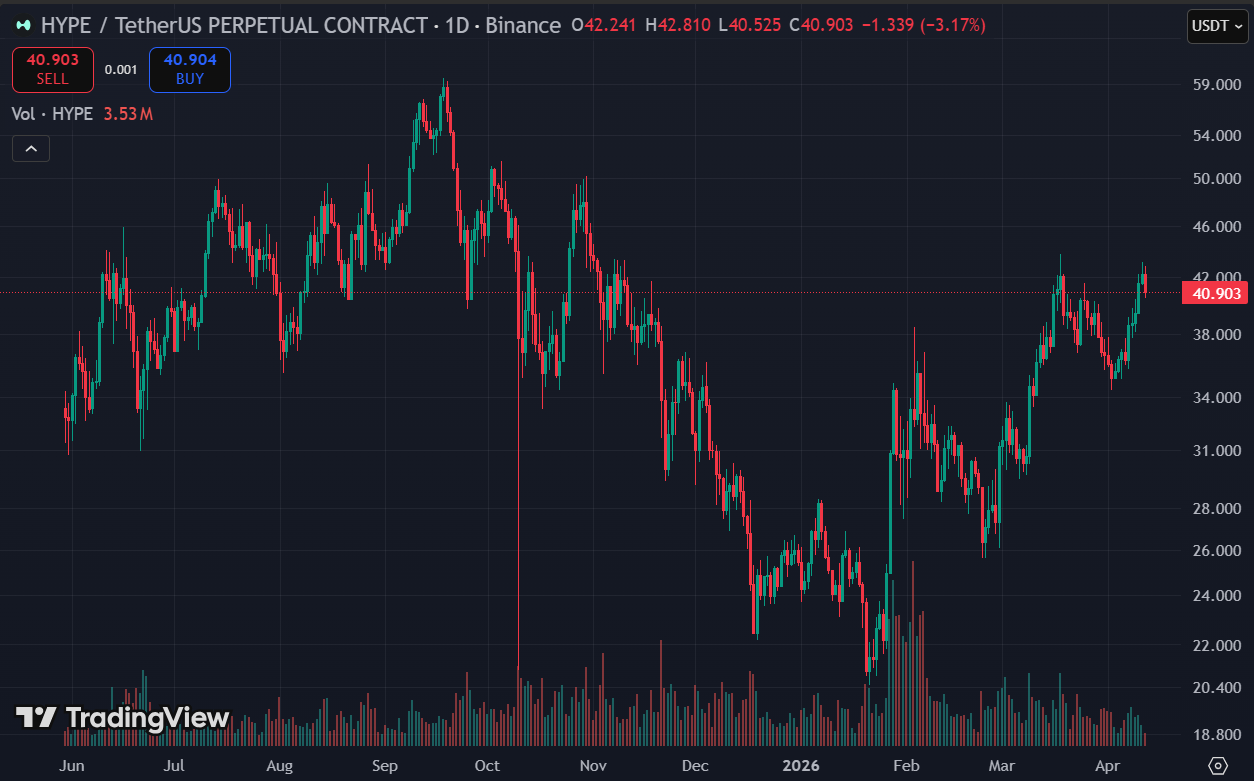
Hyperliquid $Hype price – Source: TradingView