


A study made the rounds recently claiming that cryptocurrency enthusiasts score higher than average on the so-called dark tetrad — a cluster of personality traits comprising Machiavellianism, narcissism, psychopathy, and sadism. The headline wrote itself. Impulsive psychopaths like crypto. Researchers confirm what your uncle already suspected.
The study is real. The researchers are legitimate. The conclusions are also a lot more complicated than the summary that circulated.
Here is what the research actually found and what it does not say.
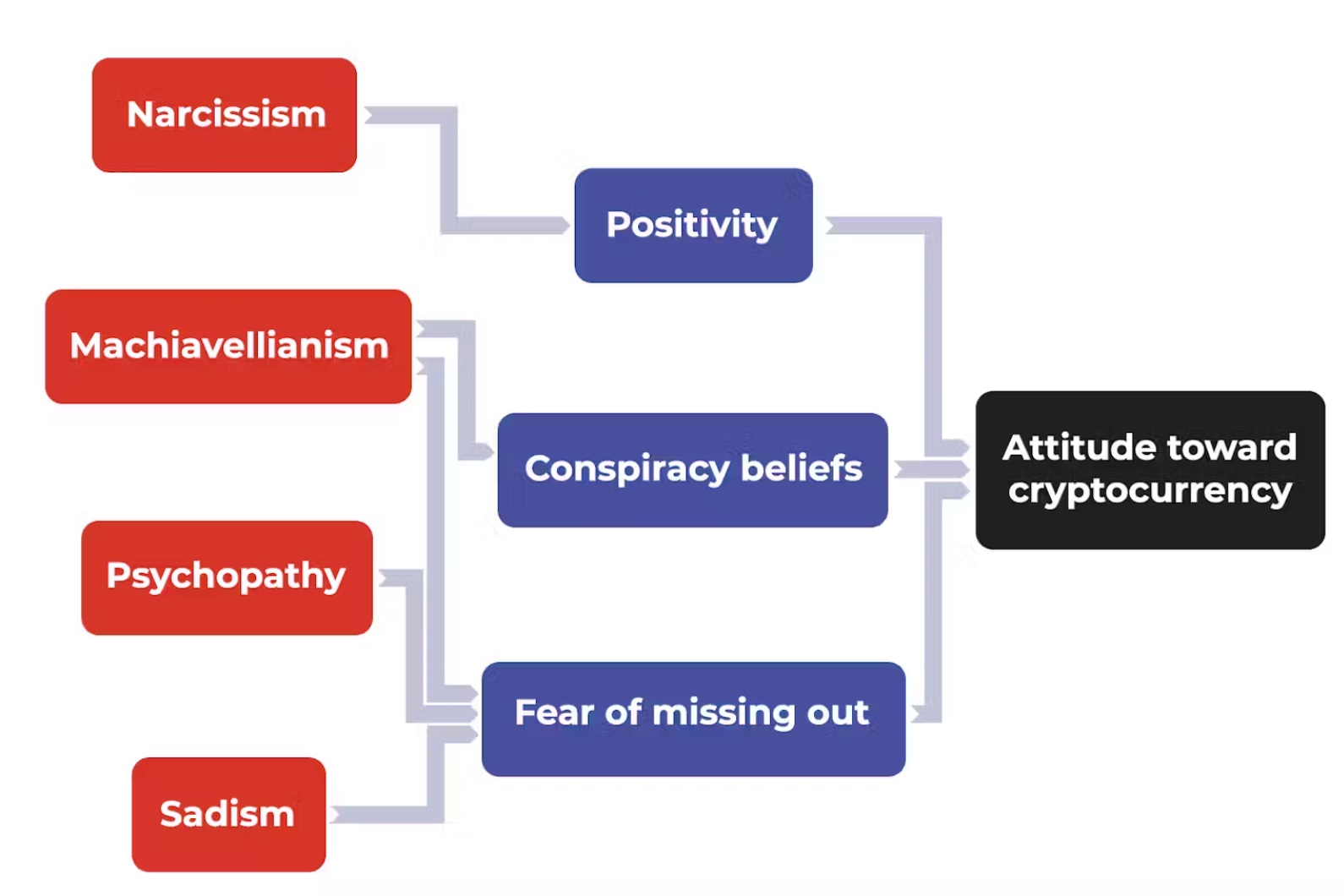
Dark tetrad personality traits that shape crypto enthusiasts personality according to theconversation.com study
What the Study Measured
The paper, published in a peer-reviewed journal and based on survey data from hundreds of participants, found statistically significant correlations between each of the four dark tetrad traits and cryptocurrency enthusiasm. The correlations are modest, not dramatic. This means people who score higher on these traits are somewhat more likely to be interested in crypto, not that crypto investors are dangerous or that the traits cause the interest.
Correlation studies of this kind have a structural problem that the headlines always ignore. If you survey enough groups about enough things you will find correlations. People who distrust institutions are more likely to distrust banks. People who are comfortable with risk are more likely to invest in volatile assets. People who are optimistic about the future are more likely to bet on emerging technology. None of that requires a dark tetrad explanation.
What Each Trait Actually Predicted
Machiavellianism, which measures distrust of institutions and belief in strategic self-interest, correlated with crypto enthusiasm because people who distrust governments and central banks are more likely to find Bitcoin’s value proposition compelling. That is not a dark finding. That is the Bitcoin thesis working as intended. Satoshi wrote the whitepaper for exactly these people.
Narcissism, which measures positive self-regard and optimism about future outcomes, correlated with crypto investment because optimistic people are more likely to invest in anything with high upside potential. The same trait that predicts crypto investment probably predicts early adoption of any new technology. The researchers did not test this comparison.
Psychopathy in this context measures impulsivity and sensation-seeking, not the clinical definition most people associate with the word. People who are comfortable acting quickly on incomplete information are more likely to trade volatile assets. This is not a personality defect. It is a temperament that is adaptive in certain environments and maladaptive in others. Crypto trading is one of the environments where it can pay off.
The sadism finding is the weakest link in the paper and the researchers acknowledged it. The proposed mechanism, that sadists enjoy watching others lose money, is speculative and not directly tested. What is more plausible is that fear of missing out, a universal human experience with no particular relationship to sadism, is driving the same behavior the researchers attributed to darker motives.
What the Study Does Not Say
It does not say most crypto investors have dark personality traits. The correlations are at a population level, meaning the average crypto enthusiast scores slightly higher on these measures than the average non-enthusiast. Slightly higher is not the same as high. Most people who are interested in Bitcoin are not high scorers on any of these dimensions.
It does not say these traits cause harm. The researchers themselves noted that people with these traits are often drawn to high-risk, high-reward environments across many domains, including entrepreneurship, finance, and early-stage technology. The traits that the study labels dark are the same traits that drive a lot of innovation.
It does not account for the specific historical moment in which people discovered crypto. Many of the people most enthusiastic about Bitcoin came to it during the 2008 financial crisis, or during periods of hyperinflation in their home countries, or after watching traditional financial institutions fail them directly. Institutional distrust in those contexts is not a personality disorder. It is a rational response to documented events.
The Part Worth Taking Seriously
Strip away the provocative framing and there is a real insight buried in this research. Crypto markets are structured in ways that reward certain psychological profiles and punish others. High impulsivity combined with high risk tolerance can generate enormous returns in bull markets and catastrophic losses in bear markets. Understanding the psychological profile of the average participant matters for understanding why crypto markets behave the way they do.
The mania phases, the meme coin cycles, the leverage cascades. These are not random. They reflect the aggregate behavior of a population that, by this study’s own finding, skews toward sensation-seeking and optimism. That is useful information for anyone trying to understand market dynamics rather than just diagnose the people involved.
The study is interesting. The headline it generated was not.
Originally published November 2023. Updated April 2026.