


PONS is up 823% in the last seven days. It is the dominant launchpad token on Robinhood Chain, the blockchain Robinhood launched on July 1, 2026. The platform has processed hundreds of thousands of token launches, generated cumulative volumes in the billions since mid-July, and burned 285 million of its original one billion token supply, roughly 28.5%, through its buyback and burn mechanism.
The price chart looks like every other new-chain narrative token. Flat. Then vertical.
The interesting part is what happened in the middle.
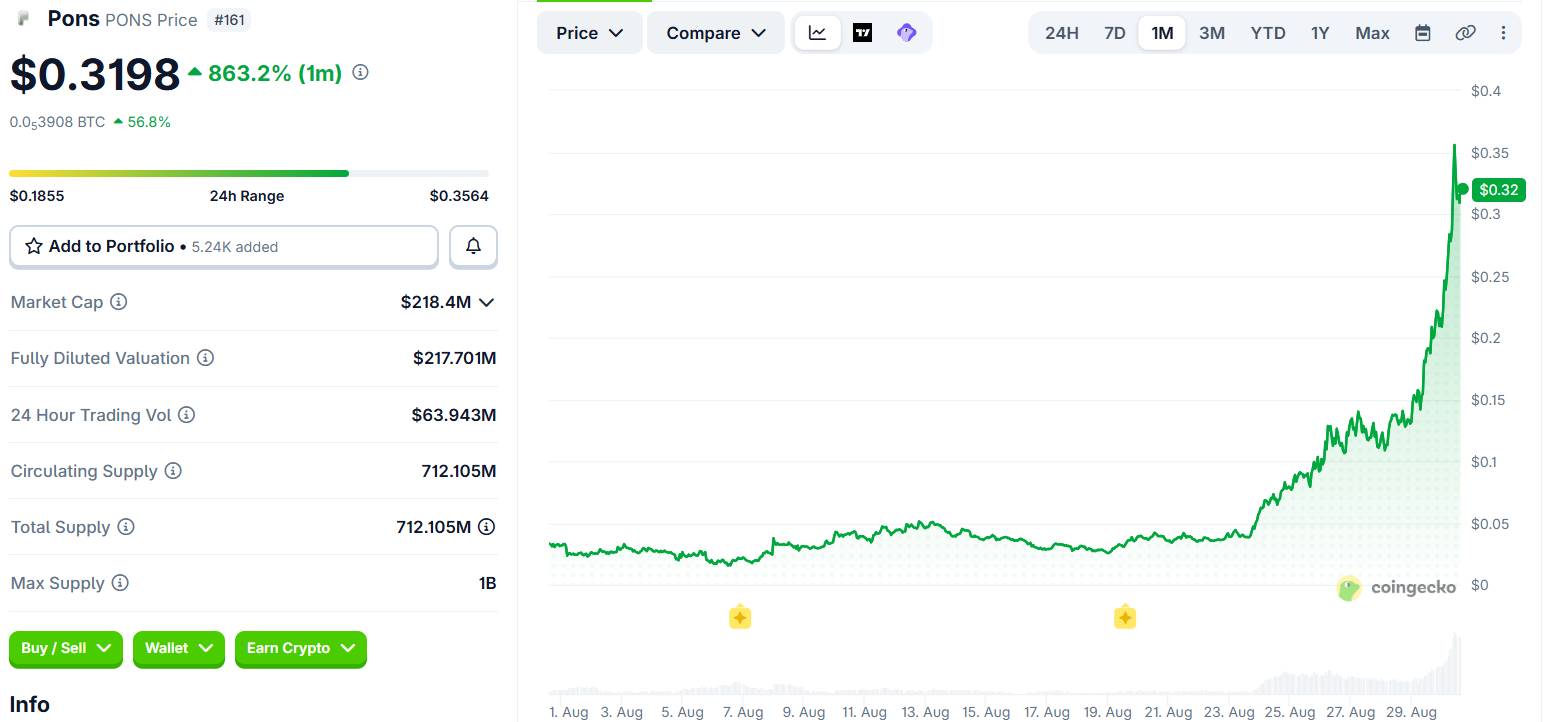
PONS Price – Source: Coingecko
What PONS Actually Is
Pons is a non-custodial token launchpad on Robinhood Chain. Anyone can deploy a fixed-supply token in minutes without writing code. Trading activity generates protocol fees. Roughly 80% of those fees flow into buybacks and burns, reducing supply continuously.
The mechanics create a direct link between platform activity and token value. More launches means more fees. More fees means more buybacks. More buybacks means less supply. It is a straightforward deflationary loop that works as long as Pons remains the dominant launchpad on the chain.
By late August Pons was capturing over 63% of Robinhood Chain launchpad volume. Daily active addresses and trading volume placed it consistently at the top of the ecosystem. The FDV to revenue multiple sat at 0.7 times, the lowest among the top 15 revenue-generating tokens in all of crypto according to Blockworks Research. Thirteenth in protocol revenue. Lowest valuation multiple in that group.
That is an unusual combination.
The Uniswap Test
On August 5, Uniswap launched Pools.trade on Robinhood Chain. Zero launchpad fees. No trading costs for creators. On its first day Pools.trade surpassed PONS in daily token launches.
PONS dropped nearly 50% in 48 hours.
The thesis behind PONS is that protocol revenue drives buybacks which drive scarcity which drives price. When Uniswap entered with a zero-fee model and immediately captured launch volume, the market concluded the revenue engine might be broken. The sell-off was mechanical and immediate.
Then PONS recovered 52% in 24 hours with no official announcement. Creators came back. Volume returned to Pons. Pools.trade won the first day and then the market decided that Pons’s existing infrastructure, its holder base, its burn history, and its cbBTC pairing support, mattered more than Uniswap’s fee advantage.
That recovery tells you something real about the product. A token that survives a Uniswap zero-fee attack on its first week of competition and returns to dominance has something beyond narrative momentum underneath it.
What the Numbers Show Now
As of August 30, PONS trades at $0.31 with a market cap of $218 million and $63 million in 24-hour volume. The circulating supply is 712 million against a one billion total supply, with 285 million already burned.
Creators have earned over $19 million on the platform since launch. The platform recently added cbBTC pairing support, allowing token launches backed by Bitcoin through Coinbase and Chainlink CCIP. Gate and KuCoin listings added centralized liquidity on top of the existing on-chain markets.
The FDV to revenue multiple is the metric worth watching. At 0.7 times, PONS is cheaper relative to the revenue it generates than any comparable token in its peer group. That either means the market is underpricing a genuine revenue-generating protocol or it means the revenue is not sustainable once competition from Uniswap and other launchpads intensifies.
The Honest Read
PONS is a one-month-old token on a two-month-old chain. The 823% gain happened in an environment where Robinhood Chain’s novelty attracted volume that may not persist at the same rate. The burn mechanism is real but the buyback policy is subject to change.
The Uniswap competition is not over. Pools.trade exists. The zero-fee model is structurally attractive to creators and Uniswap has resources PONS does not. The first week showed PONS can survive that competition. It did not show it can dominate indefinitely.
What the last month showed is that Pons built something with real usage before the token narrative took over. 63% of launchpad volume, $19 million in creator earnings, 285 million tokens burned. Those are on-chain facts verifiable by anyone. In a market where most new-chain tokens are pure narrative with no activity underneath them, that distinction matters.
Whether it matters enough to justify $218 million at one month old on a two-month-old chain is the question the next 30 days will answer.