


At block 961,632, estimated to arrive Saturday, a minority of Bitcoin nodes will begin rejecting blocks that do not carry a specific signal. The miners producing those blocks have shown almost no interest in carrying it. As of Thursday, 2.56% of blocks have signaled support for BIP-110. The threshold for activation is 55%.
The soft fork is going to fail. That much is clear from the numbers. What is less clear is what happens next, and that is the part worth paying attention to.
What BIP-110 Actually Is
BIP-110, formally called the Reduced Data Temporary Softfork, is a proposed one-year rule change that would cap how much arbitrary data a Bitcoin transaction can carry. It targets Ordinals inscriptions, large OP_RETURN payloads, and certain Taproot constructions used for data storage rather than payments.
Supporters frame it as defending Bitcoin’s role as a monetary network against people using it as a data storage layer. Critics frame it as censorship of valid transactions, with the BIP’s own editor describing it as “a misguided and unusually careless softfork proposal” before publishing it anyway because it met the repository’s criteria.
The proposal ships in Bitcoin Knots, a smaller Bitcoin client maintained by Luke Dashjr. Bitcoin Core, the dominant client, does not include it. Roughly 22.65% of nodes are currently running Knots. The rest are not.
When the mandatory signaling window opens at block 961,632, Knots nodes enforcing BIP-110 will reject any block that does not set version bit 4 in its header. Major mining pools, Foundry, Antpool, ViaBTC, and F2Pool, have not signaled. Ocean pool has produced the majority of signaling blocks since the first appeared, but Ocean’s hashrate is a small fraction of the network.
The result is a minority of nodes enforcing a rule that the majority of miners are ignoring. That creates a temporary chain split: BIP-110 nodes on one side rejecting non-signaling blocks, the rest of the network continuing normally.
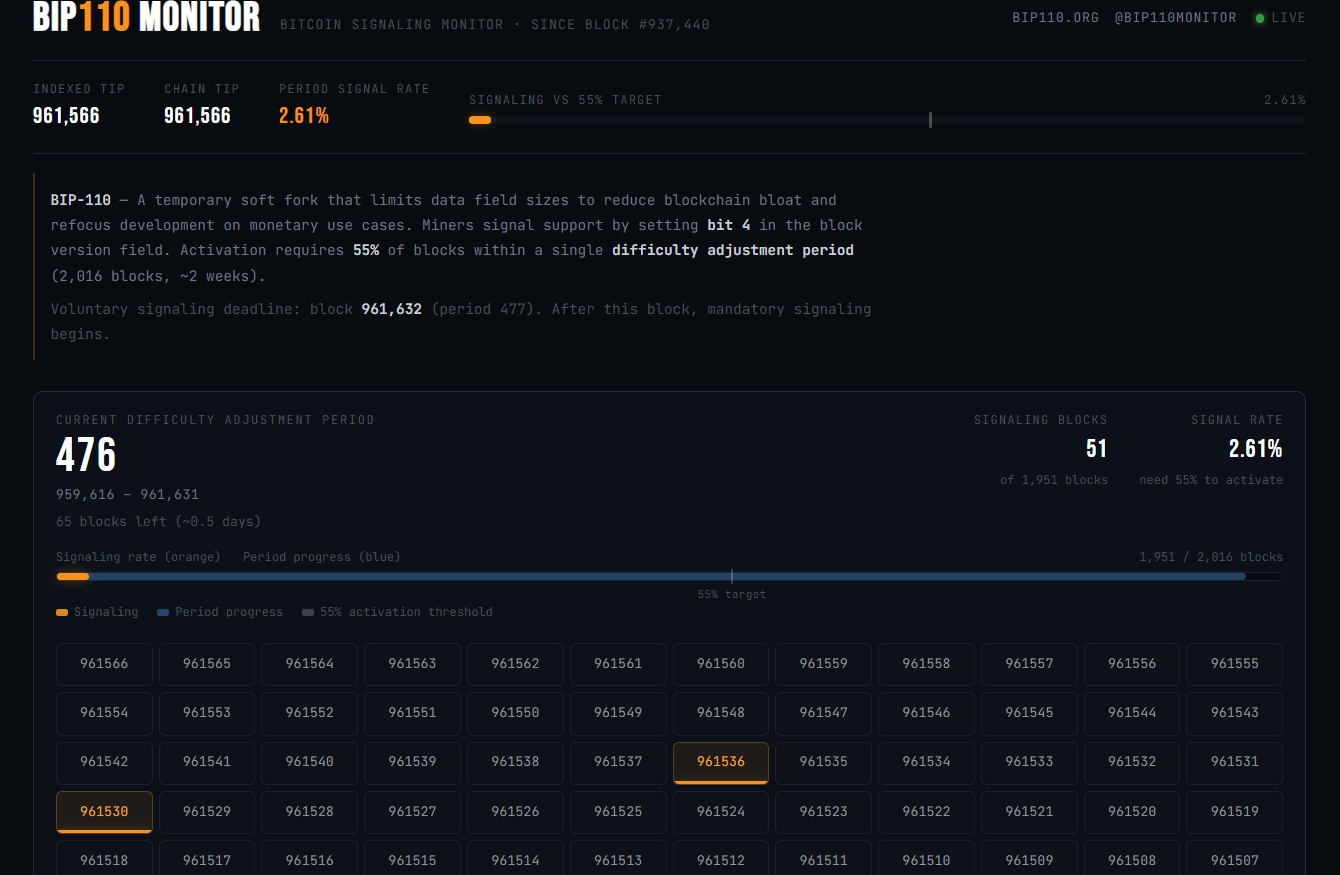
51 blocks signaling out of 1,951. The 55% threshold requires 1,109. Mandatory signaling begins at block 961,632 in roughly 12 hours from time of publication. Source: BIP-110 Monitor
The Part Nobody Is Saying Clearly
The soft fork is almost certainly going to fail on the numbers. But the developer who wrote the activation code has a contingency, and the contingency is more disruptive than the soft fork itself.
Luke Dashjr has stated that a proof-of-work change is the only remaining option if BIP-110 fails. Developer Chris Guida has already rebased Dashjr’s 2017 PoW hard fork code onto Bitcoin Knots in preparation. A PoW hard fork would change Bitcoin’s mining algorithm entirely, making existing ASIC hardware obsolete on the new chain and requiring miners to acquire different equipment to participate.
That is not a soft fork. That is a hard fork, a permanent split creating two separate chains, two separate assets, and two competing claims to the name Bitcoin. The 2017 version of this fight produced Bitcoin Cash. This version would be happening with Bitcoin at a $1.3 trillion market cap rather than the one it had in 2017.
Michael Saylor told BIP-110’s backers to stand down. Adam Back put it more directly:
the reason it doesn’t have consensus is it’s stupid idea, doesn’t work, and completely fails at technical consensus. polar opposite to segwit which did have technical AND ecosystem consensus (modulo a later stage attempt to abuse the activation process to veto what was agreed)
— Adam Back (@adam3us) June 8, 2026
The BIP’s own pseudonymous author told users to stop running Bitcoin Core, describing it as insecure once mandatory signaling begins, a claim that does not appear anywhere on the project’s own website.
Both camps are describing the same block. They disagree entirely on what happens after it.
What Actually Matters for Holders
If the weekend passes without a significant miner shift, BIP-110 stalls and the network continues normally. That is the most likely outcome based on current signaling numbers. Bitcoin Core nodes, which represent the vast majority of the network, are not enforcing BIP-110 rules and will keep following the longest valid chain regardless.
The risk is not this weekend’s mandatory signaling window. The risk is what Dashjr does with the PoW contingency if BIP-110 fails and he decides the fight is not over.
Bitcoin’s consensus has not changed since Taproot activated in November 2021. That is the longest quiet stretch in its history. The people trying to change it now do not have miner support, do not have user majority support, and are describing a mechanism where minority nodes reject majority blocks.
That is not how Bitcoin has historically changed its rules. It is also not nothing.