


Key Takeaways
- XRP spot ETFs recorded $1.6 billion in cumulative inflows while Bitcoin ETFs ran a record $2.97 billion outflow streak
- Whale wallets added 1.53 billion XRP over six months, reducing exchange supply ahead of a 9% weekly price jump
- Ripple acquired an equity stake in Flutterwave, valuing the African fintech at $3.3 billion, to embed RLUSD and XRPL into African payment rails
- The XRPL version 3.2.0 upgrade activated June 15, reducing node memory consumption by up to 40%
- XRP faces key resistance at $1.28 to $1.30 actually down to $1.12 a drop by 13%
XRP ETF Inflows Diverge From Bitcoin and Ethereum
While Bitcoin ETFs ran their longest outflow streak of 2026 and Ethereum funds bled for 14 consecutive days, XRP products are pulling institutional money in.
US spot XRP ETFs recorded $1.6 billion in cumulative net inflows as of mid-June 2026, with seven funds now operating and 773 million XRP tokens in custody. For the week ending June 12, XRP spot ETFs posted $10.68 million in net inflows, their second consecutive positive week. On June 15 alone, spot XRP ETFs attracted $2.82 million in net inflows on the same day Bitcoin ETFs posted a $64.09 million net outflow.
That divergence is the key signal. When institutional capital rotates out of Bitcoin and into XRP ETFs during a broad crypto selloff, it reflects a specific bet on XRP’s structural catalysts rather than general crypto exposure.
Goldman Sachs allocated nearly $154 million to XRP ETFs during this period. JPMorgan’s forecast of $4 to $8.4 billion in first-year inflows has not yet been fully tested by a bull cycle. Total XRP ETF AUM reached $978.86 million as of June 12, approaching the $1 billion threshold that historically triggers additional allocator attention in traditional finance.
Whale Accumulation Signals Institutional Confidence
Large holders added 1.53 billion XRP over the past six months, according to on-chain data. This supply reduction happened while XRP’s price was under pressure, meaning whales were accumulating into weakness rather than chasing strength.
Exchange balances declined during the same period, reducing the available float and tightening supply. When price then jumped 9% in a single week, the move had a reduced supply base to work against, which amplifies the percentage gain.
Binance’s estimated XRP leverage ratio has dropped roughly 78% from mid-2025 highs. Lower leverage means violent liquidation cascades are significantly less likely than they were at the peak. The technical setup is cleaner than it has been in over a year.
Ripple Enters Africa With $3.3 Billion Flutterwave Deal
On June 16, 2026, Ripple acquired an equity stake in Flutterwave as part of the African fintech company’s Series E funding round at a $3.3 billion valuation. The deal integrates Ripple’s RLUSD stablecoin, Ripple Payments, and the XRP Ledger into Flutterwave’s cross-border payments network.
Flutterwave processes payments across Sub-Saharan Africa, a corridor where on-chain flows topped $205 billion over the past 12 months. RLUSD has a $1.6 billion market cap and ranks 10th among stablecoins globally. Embedding it into Flutterwave’s infrastructure means RLUSD gains access to one of Africa’s dominant payment rails without building that infrastructure from scratch.
Ripple’s regional director Reece Merrick described the intent directly: embedding RLUSD within Flutterwave’s infrastructure with the aim of deepening XRPL’s role as a settlement layer for real-world payments across the continent.
XRP’s price response has been modest following the announcement. This reflects a recurring pattern with XRP: enterprise adoption does not translate directly into immediate token price appreciation. The Flutterwave deal strengthens the long-term utility argument but does not change near-term price mechanics.
XRPL Version 3.2.0 Upgrade Goes Live
The XRP Ledger activated version 3.2.0 on June 15, 2026. The upgrade reduces node memory consumption by up to 40%, increases transaction throughput, and improves network stability. The core server software was also renamed from “rippled” to “xrpld” to reflect the ledger’s operational independence from Ripple the company.
Daily transactions on the XRPL hit 3 million on March 15, 2026, a threefold increase from mid-2025 averages, driven by AMM pool growth, tokenized assets, and RLUSD-denominated settlement flows. Real-world asset tokenization on XRPL has grown to over $474 million with total represented value approaching $1.5 billion.
The technical upgrade positions the network to handle increased institutional transaction volumes without degrading performance.
XRP Price Levels to Watch
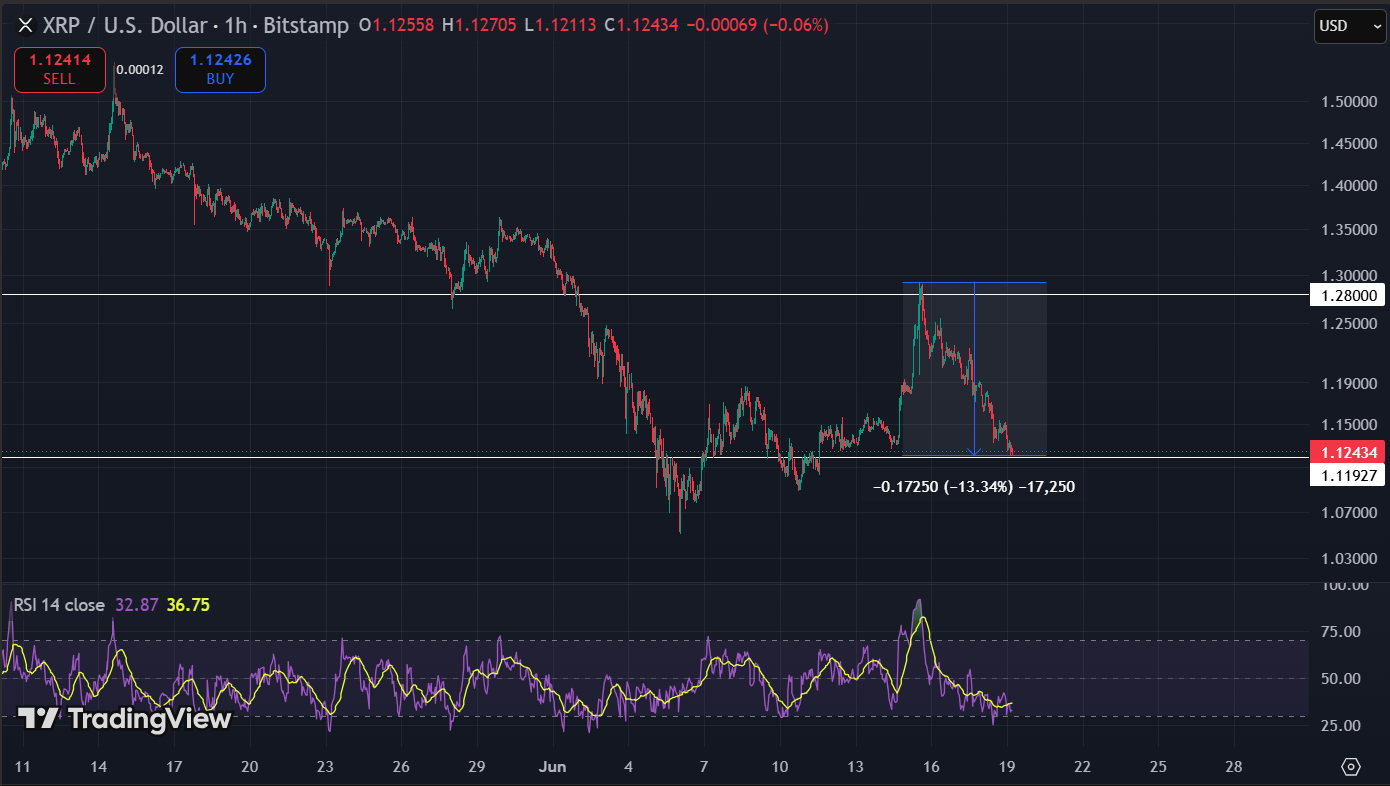
XRP Chart Source: TradingView
XRP is currently trading at $1.12, having tested and failed at the $1.28 to $1.30 resistance zone on June 15 before pulling back 13.34%. That level is now the ceiling traders are watching again.
Resistance: $1.28 to $1.30 is the immediate ceiling. XRP already tested this band on June 15 and was rejected. A clean break above it with sustained volume could open a move toward the $1.80 swing level that longer-term frameworks are targeting. 21Shares assigns a 30% probability to XRP reaching $2.69 by year end, with a base case near $2.45 contingent on continued ETF inflows and utility traction.
Support: $1.12 to $1.15 is the current floor, where XRP is sitting now. RSI at 36.75 is approaching but not yet at oversold territory.
The macro backdrop has improved following the US-Iran peace deal, which has given the broader altcoin complex a lift. Whether XRP can make a second attempt at $1.28 depends on whether that support holds here.
FAQ
Why are XRP ETF inflows rising while Bitcoin ETFs are seeing outflows? Institutional investors are rotating into XRP specifically because of its structural catalysts: the SEC lawsuit settlement, seven spot ETF products now live, the Flutterwave partnership expanding real-world utility, and the XRPL upgrade improving network performance. Bitcoin ETFs have faced profit-taking after a prolonged period of elevated prices, while XRP’s lower price relative to its 2025 highs makes it an attractive entry point for new institutional allocations.
What is the Ripple Flutterwave deal and why does it matter for XRP? Ripple acquired an equity stake in Flutterwave as part of a $3.3 billion Series E round. The deal integrates RLUSD stablecoin and XRP Ledger technology into Flutterwave’s cross-border payments network across Sub-Saharan Africa. The corridor processed over $205 billion in on-chain flows in the past 12 months. For XRP, the deal strengthens the long-term utility case by embedding XRPL into real payment infrastructure serving a continent of 1.4 billion people.
What did the XRPL 3.2.0 upgrade change? The June 15 upgrade reduced node memory consumption by up to 40%, increased transaction throughput, and improved overall network stability. It also renamed the core software from rippled to xrpld to emphasize the ledger’s independence from Ripple the company. The upgrade prepares the network for higher transaction volumes as institutional adoption and RLUSD usage continue to grow.
What is the XRP price target for 2026? 21Shares assigns a base case of $2.45 for XRP by year end, contingent on continued ETF inflows and utility traction from partnerships like Flutterwave. A 30% probability scenario places XRP at $2.69. Near-term resistance sits at $1.28 to $1.30, a level XRP already tested on June 15 before being rejected back to current levels. A sustained break above that zone would be the first step toward the $1.80 swing target longer-term frameworks are watching. These are analyst projections and not financial advice.