


In March 2026 the Ethereum Foundation sold 5,000 ETH to BitMine. In April it sold another 10,000. On May 1 it sold 10,000 more. That is 25,000 ETH, roughly $58 million, sold by the organization that is supposed to be Ethereum’s most committed long-term steward.
Eight senior contributors have left since January 2026, five of them in May alone.
ETH is down 65% against Bitcoin since the Merge.
These facts are connected.
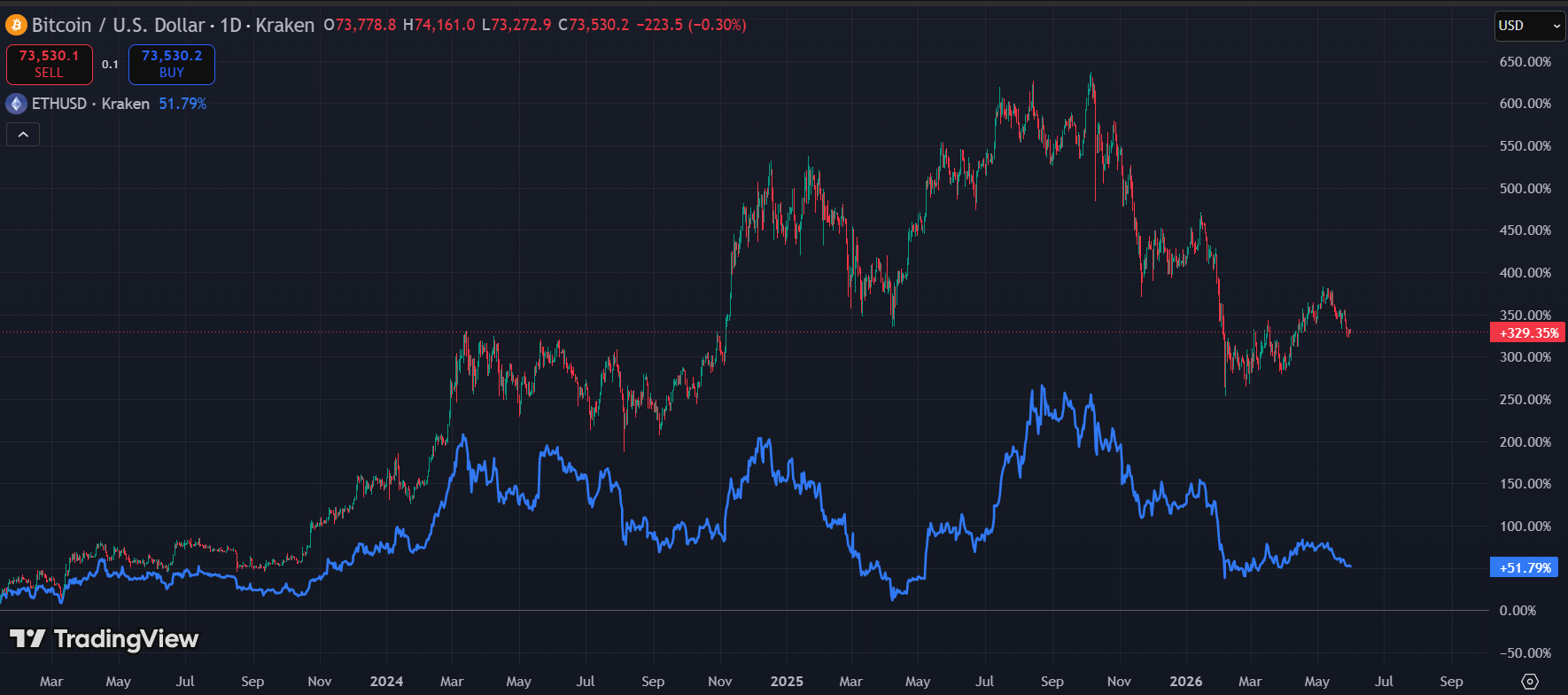
Bitcoin up 329% since March 2023. ETH up 51.79% over the same period. The divergence is the ETH/BTC ratio collapse in chart form. Source: TradingView / Kraken
The Governance Crisis
The Ethereum Foundation is facing its most concentrated wave of internal criticism in years. Carl Beek, involved in the Beacon Chain launch, and cryptoeconomics researcher Julian Ma both announced exits on May 18. The flashpoint was the Foundation’s March 13 Mandate, described internally as “part constitution, part manifesto, and part guide.” Critics read it as codifying the hands-off approach at exactly the moment Ethereum needs the opposite.
The people leaving did not find that convincing.
The Insider Who Named the Problem
Reid, an ICO-era builder still long ETH, published the most specific critique of the Foundation written by someone inside it. He did not blame coordination problems or market cycles. He named decisions and dates. His article on X : Ethereum: Executive chairman emeritus
Three charges.
The wrong message at the wrong moment
The Merge’s 99.95% energy reduction answered questions capital allocators never asked. Institutions wanted yield. Developers wanted finality. Users wanted cheaper transactions. Solana shipped wallets, DEXs, and money markets during the same window. The Foundation issued a press release about electricity.
Seven years to ship proof-of-stake, three years to not ship a staking button
Proof-of-stake sat on the roadmap from 2015. It took until 2022. Three years after the Merge, there is still no first-party staking interface. The official path requires 32 ETH minimum, roughly $64,000 at current prices. Most users route through Lido, which holds 24% of all staked ETH despite years of centralization warnings from Ethereum’s own developers.
Reid’s verdict: “We don’t pick winners is what an organization says when it does not want to compete.”
The rollup roadmap that drained the base layer
EIP-4844 pushed blob fees to near zero. Ethereum’s quarterly fee revenue fell roughly 95% from its Q4 2021 peak of $4.3 billion. Arbitrum captures 90% to 98% operating margins. Base captured 70% of rollup profits. Every major L2 issued its own token, fragmenting capital that might have accrued to ETH. Solana captures fees directly at the L1. The architectural choice had a price and the ETH/BTC ratio paid it.
The Philosophy Problem
Vitalik’s peak net worth was $2.09 billion in November 2021. It now sits between $467 million and $750 million, nearly every dollar on-chain. In January 2026 alone he donated 16,384 ETH, approximately $43 million, to open-source infrastructure.
The philosophical cost of “we don’t pick winners” does not land on the person with $500 million in on-chain assets. It lands on the retail holder who bought ETH at $4,000 in 2021 and is watching it trade below $2,000.
It is easy to develop objections to competition once you have already won.
The Selling Question
We covered the Foundation’s ETH sales to BitMine when they started. What has become clear is the pattern: 25,000 ETH sold at $2,000 to $2,400 per coin while the asset sits 65% below its all-time high and 65% below Bitcoin’s performance since the Merge.
The Foundation selling ETH to fund operations is not new. The volume, the frequency, and the timing are. It tells the market that the Foundation’s own treasury management does not reflect conviction that ETH is undervalued. Whether that reading is fair or not, it is the reading the market makes.
What Vitalik Actually Said
The Foundation holds 0.16% of all ETH, Vitalik said, well below the 10% to 50% common at other foundations. The EF is ‘one node with a defined purpose,’ not Ethereum’s center. Maximizing throughput leads to mediocrity. Ethereum must be ‘deeply impressive’ in CROPS dimensions
The market’s response is the ETH/BTC chart.
Where This Ends
Reid is still long ETH. His critique is about execution debt, not terminal failure. The network is still the dominant smart contract platform. The developer ecosystem is the largest in crypto.
But eight departures and a 65% underperformance against Bitcoin say the critics have a point. The question is whether the Foundation’s philosophical posture is compatible with competing against chains that are not neutral about winning.
That question does not get answered in a blog post. It gets answered in the ETH/BTC ratio over the next twelve months.