
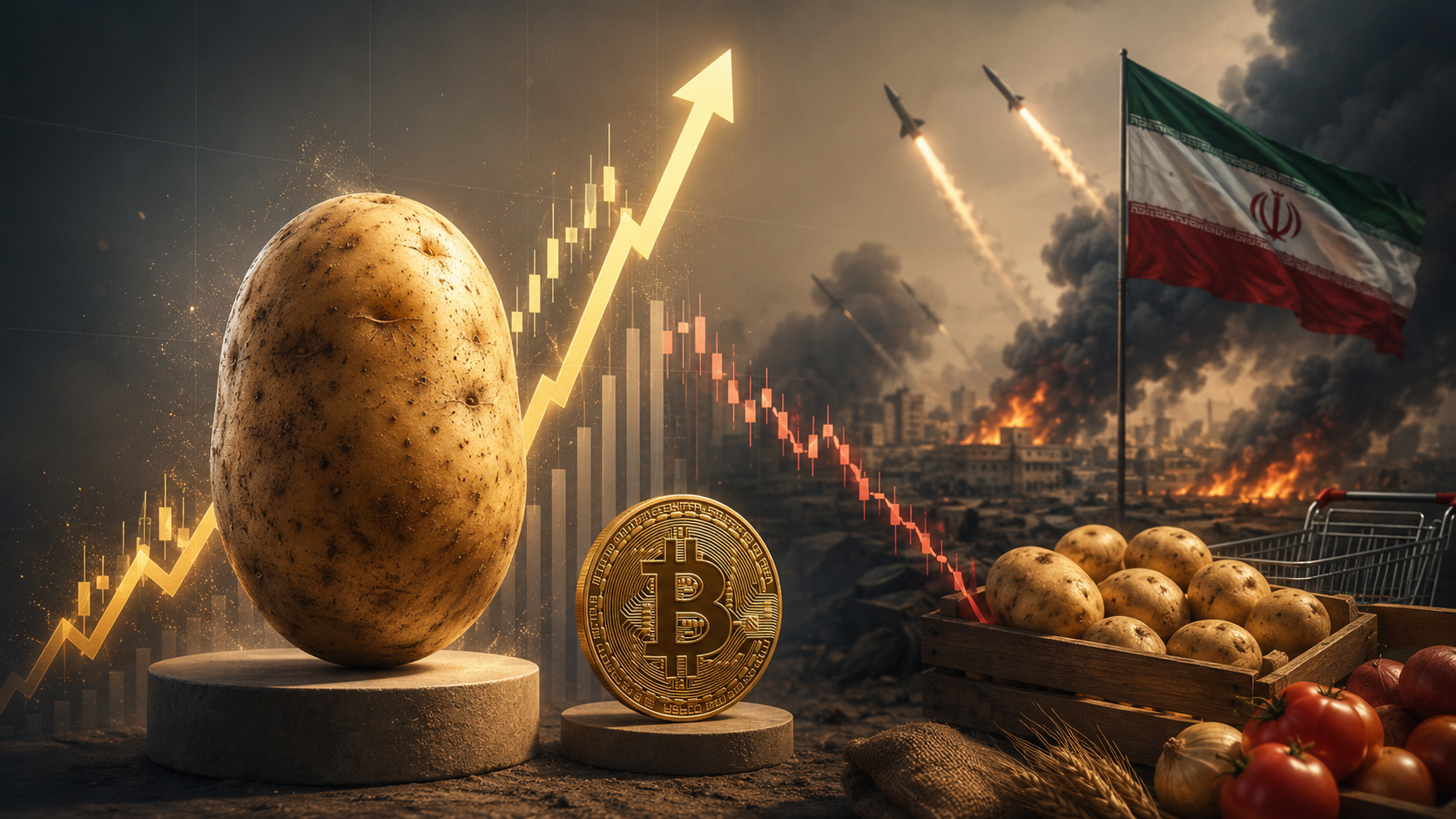
Bitcoin gained 13.1% last month. The Nasdaq added 15%. Gold slipped. Oil was mixed.
A potato contract beat all of them by more than 40 times.
Potato CFDs surged roughly 705% in under a month, rising from approximately €2.11 per hundred kilograms on April 21 to €18.50 today. The physical potato market in Europe is in oversupply. Farmers in Belgium, the Netherlands, France, and Germany expanded planting after previous shortages, produced exceptional harvests, and flooded the continent with a surplus nobody needed. Potatoes are cheap and plentiful. The financial contracts tracking them are not.
This is not a story about potatoes. It is a story about what war does to the boundary between commodity and speculation.
If you invested $125k in potatoes last month, you’d be a millionaire today because Potato prices pumped +704% in the last month.
Bro, we are now getting outperformed by fucking potatoes. pic.twitter.com/5Mye2Kmmw7
— Ash Crypto (@AshCrypto) May 8, 2026
The Hormuz Connection
The reason potato derivatives are moving has nothing to do with potato supply. According to the UN, roughly a third of the world’s fertilizers pass through the Strait of Hormuz, including urea, potash, ammonia, and phosphates. Since the US and Israel launched strikes on Iran on February 28, that traffic has effectively halted. Urea prices jumped 50% since the start of the war. Anhydrous ammonia rose from $828 per ton before the conflict to $1,123 per ton by April 17.
No fertilizer through Hormuz means higher production costs for next season’s harvest. Higher production costs mean lower yields. Lower yields mean tighter supply down the road. Traders are not buying physical potatoes. They are buying the fear of what happens to potato supply six to twelve months from now if the Strait stays closed.
The Strait of Hormuz closure is the largest disruption to world energy supply since the 1970s energy crisis, and its effects are rippling through every supply chain that touches the Persian Gulf. Aluminum, helium, LNG, fertilizer, and now food derivatives are all repricing around the same chokepoint.
What This Tells You About War Pricing
Every major war creates a new class of speculative asset. After Russia invaded Ukraine in 2022, wheat futures moved like tech stocks. Shipping rates became a proxy for geopolitical risk. Commodity traders who understood the supply chain implications made returns that equity investors could not touch.
The Iran war has done the same thing but at a larger scale because the Strait of Hormuz is a more critical chokepoint than anything Ukraine disrupted. Around 30% of globally traded fertilizers, 20% of LNG, and 27% of globally traded oil normally transit through the strait. When that corridor closes, everything downstream reprices. Including potatoes.
The investors who understood this in late February, when the war started and Bitcoin was falling from $95,000, were not buying Bitcoin or gold. They were buying fertilizer futures, agricultural derivatives, and anything with direct Hormuz supply chain exposure. That trade has now returned 705% on potato CFDs alone while Bitcoin was recovering from its war-induced bottom.
Where Does Bitcoin Fit In This
Bitcoin gained 13.1% over the past month. That recovery happened despite the Iran war, not because of it. The war initially crashed Bitcoin from $95,000 to below $65,000 when it started. The subsequent recovery was driven by ETF inflows, CLARITY Act momentum, and improving risk sentiment as ceasefire talks developed.
Bitcoin is not a war volatility proxy. It is a monetary debasement proxy. When governments print money to fund wars, Bitcoin benefits. When wars create acute supply chain disruptions with identifiable commodity exposure, agricultural derivatives benefit faster.
These are different theses for different time horizons. The potato trade was a six-week trade driven by a specific and identifiable supply chain disruption. The Bitcoin thesis plays out over years as the monetary consequences of war spending compound.
The investors who made 705% on potato CFDs and the investors who hold Bitcoin through the war are not the same people making the same bet. They are making completely different arguments about how war transfers value across asset classes.
The Part That Does Not Get Said
The 705% move in potato derivatives does not mean potatoes are expensive. Physical potato prices in Europe remain below where they traded over the past two years because of the oversupply. Euronews noted that the move reflects financial markets reacting to volatility, not any actual scarcity in physical potato inventories.
What it means is that financial markets have gotten extremely good at front-running supply disruptions that have not happened yet. The gap between physical reality and financial pricing is now so wide that a commodity sitting in oversupply can produce a 700% return on its derivative while the physical price barely moves.
This is not new. It is exactly what happened to natural gas derivatives in 2021, wheat futures in 2022, and shipping rates throughout the pandemic. What is new is the speed and scale. The Iran war created this gap in weeks, not months.
Bitcoin sat through all of it and is now back above $81,000. The supply schedule did not change. The monetary argument did not change. The 13.1% gain looks modest against 705% until you account for the fact that potato CFDs will retrace when the Strait reopens and Bitcoin will not.
One of these trades has an expiry. The other one does not.