
Update April 21, 2026: Rave completes the full Burj Khalifa pattern. it falls 98% to $0.5, erasing $6.7 billion from its market cap in two days.
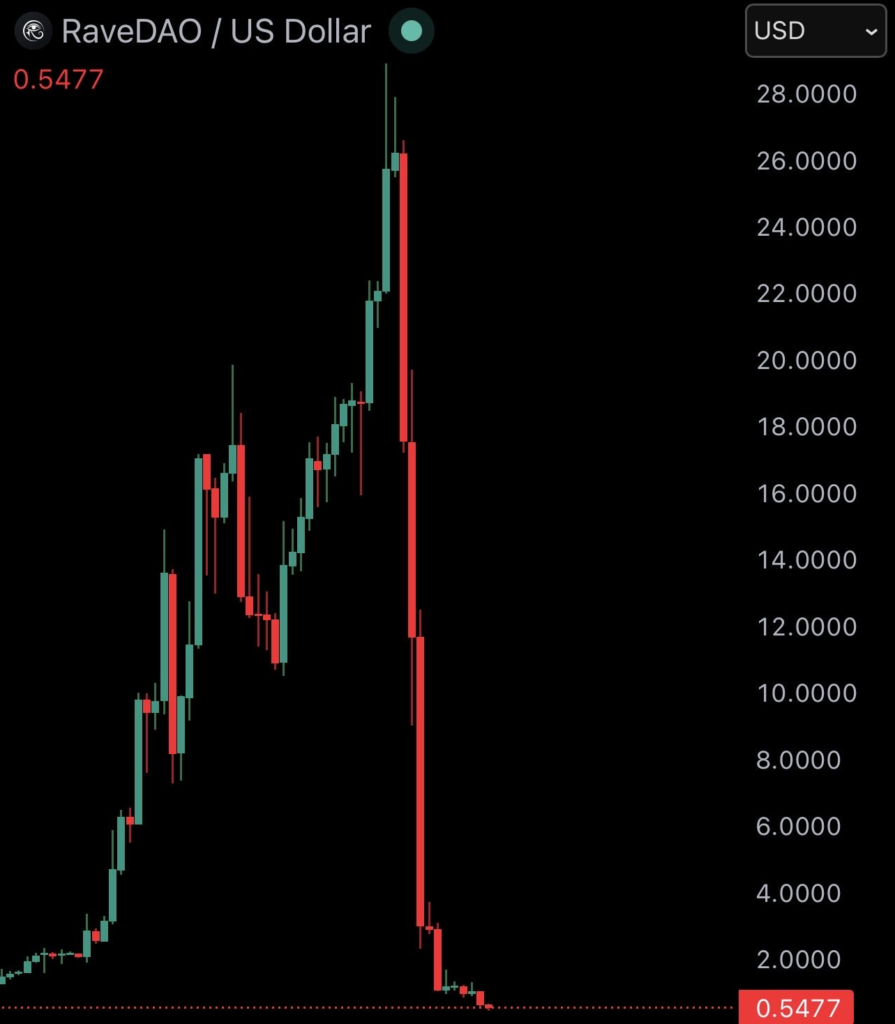
A token called RAVE went from $0.25 to $28 in eleven days. Its market cap briefly surpassed $6 billion, placing it above Litecoin and Avalanche in the rankings. Retail traders were posting screenshots. Crypto influencers were calling it the next big thing.
Then Bitget announced it was investigating alleged manipulation. RAVE dropped more than 50% within hours.
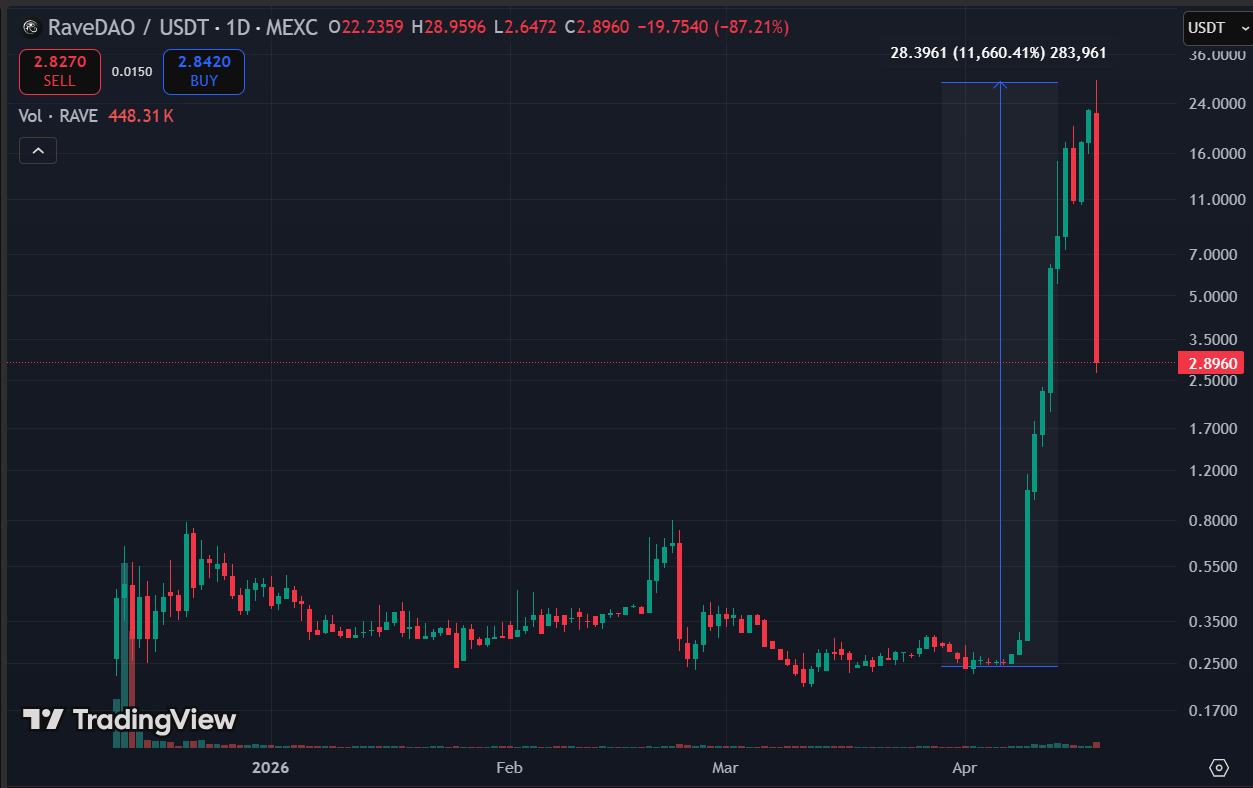
$RAVE Went Up 11,000% Source: TradingView
Here is what actually happened.
The setup
RaveDAO is a Web3 music protocol connecting live events with blockchain participation. That is the official description. The token launched in late 2023, went nowhere for over a year, and by early April 2026 was trading at $0.25 with a market cap of roughly $62 million. Nothing about the project had changed fundamentally. There was no product launch, no major partnership, no protocol upgrade.
What changed was the positioning.
Ten hours before the rally began, wallets linked to the RaveDAO deployer transferred 18.58 million RAVE tokens to Bitget. No public announcement. No disclosure. The price was still below $0.50. A large deposit to an exchange is typically read by the market as a signal of incoming sell pressure. Traders noticed. Short positions piled up. On Binance, 74% of trading accounts were positioned short heading into the surge.
Then the team withdrew the tokens back on-chain. The sell pressure that traders had been positioning against evaporated. With 90% of the total supply locked in three wallets controlled by insiders, there was almost no float available to absorb buying pressure. The short squeeze began. Traders who had bet against RAVE were forced to buy back at higher and higher prices. Annualized funding rates hit between 2,700% and 4,800% on some platforms. The price did not stop until $28.
The mechanics of the trap
This was not a standard pump and dump. It was more sophisticated than that.
The operation used what analysts are calling a deposit-withdraw deception. Move tokens to an exchange, create the appearance of imminent selling, let retail and algorithmic traders load up on shorts, withdraw the tokens, then squeeze the shorts into oblivion using a token supply so concentrated that price resistance essentially does not exist. The insiders do not need to sell into the pump. The short liquidations generate the profit.
A team-linked multisig wallet activated days before the pump, accumulating $43.66 million worth of RAVE at an average of $1 per token, already a 600% gain from entry. Combined with other wallets, the group controlled roughly 80% of circulating supply. With that level of concentration, anyone who shorted the token was not trading against a free market. They were trading against a coordinated operation that controlled the price.
RaveDAO’s own communications during the rally are worth noting. While the token was doing 6,000%, the project’s official account posted a statement urging users to “remain mindful of the associated risks and exercise caution, particularly when using leveraged positions.” That is the kind of warning you post when you know what is coming and do not want legal exposure. It is not the kind of warning you post when you are surprised by your own token’s performance.
ZachXBT’s call
ZachXBT contacted RaveDAO’s co-founder eight hours before publishing his findings publicly. The co-founder read the message and did not respond. ZachXBT published anyway, calling it a pump-and-dump with insiders controlling over 90% of supply, and called on Binance, Bitget, and Gate.io to investigate and remove the responsible actors. He offered a $10,000 personal bounty for whistleblowers, later raised to $25,000.
Bitget CEO Gracy Chen confirmed the exchange had initiated an investigation. RAVE dropped 50% within hours of the announcement.
Over 752 million locked team tokens remain. If dumped, analysts estimate an 80% crash from wherever the price stabilizes. Anyone still holding RAVE is essentially holding a position in a token where the people who control 90% of supply have every financial incentive to exit.
What this exposes about exchanges
The more uncomfortable question is not what RaveDAO did. It is what Binance, Bitget, and Gate.io allowed to happen on their platforms.
88% of RAVE spot trading happened on Bitget. The deployer wallets moved tokens to Bitget hours before the pump. The exchange listed RAVE futures, which provided the leverage that made the short squeeze profitable at scale. Whether Bitget’s systems flagged any of this before ZachXBT did is a question the investigation will need to answer.
Centralized exchanges have compliance teams, on-chain monitoring tools, and the ability to freeze wallets in real time. The RAVE operation played out over days, not seconds. The on-chain footprint was visible to anyone running basic analytics. The fact that the investigation only started after public pressure from an independent researcher is not a great advertisement for exchange self-regulation.
The honest summary
RAVE went from $0.25 to $28 because insiders with 90% of the supply engineered a short squeeze using a deposit-withdraw deception on a centralized exchange. Retail traders who bought in at $8, $10, or $15 were not early. They were the exit liquidity. The insiders extracted profit through funding rates and position management, not through selling tokens at the top.
ZachXBT found the receipts. Bitget opened an investigation. The token crashed.
This is not an unusual story in crypto. What makes it worth reading is the precision of the operation and the scale it reached before anyone with institutional authority did anything about it. A $6 billion market cap manipulation scheme that ran for eleven days before an independent researcher with a Twitter account stopped it.
That is the state of market integrity in 2026.
This article is not financial advice. Do your own research.