


ORDI went from $2.22 to nearly $9 in roughly 48 hours. A 300% move on a token that had been grinding sideways below $3 for months. Everyone wants to know why.
The honest answer is less exciting than the chart looks.
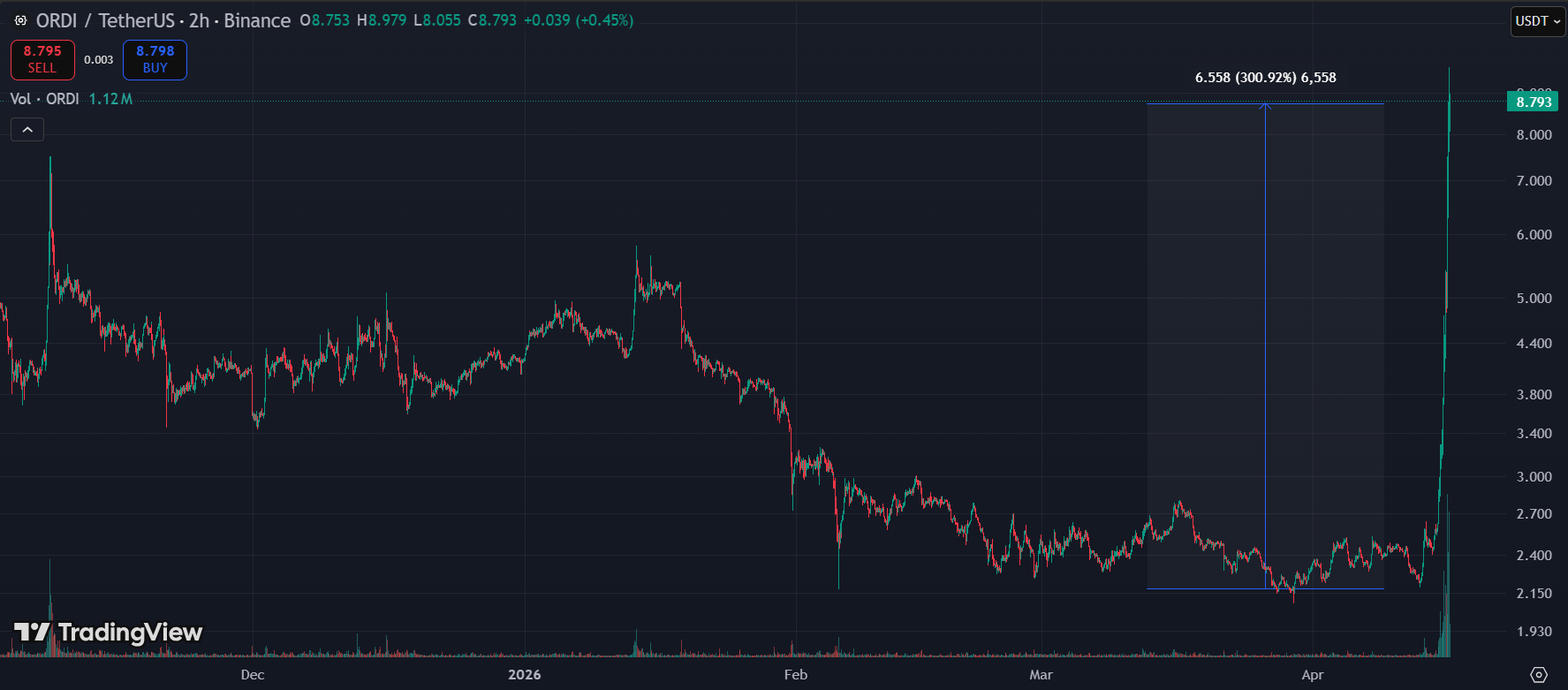
Ordi price – Source: TradingView
What the data shows
Trading volume on ORDI exploded 793% in 24 hours to $171 million. That is the number that explains everything. ORDI’s market cap was sitting around $75 million before the move. When $171 million in volume hits a token that small in a single day, the price does not move gradually. It goes vertical.
This is a textbook short squeeze. ORDI had been in a two-year downtrend, falling from an all-time high of $96 in March 2024 to below $2.50 in March 2026. A 97% drawdown over two years creates a very specific market structure: a lot of bearish positioning, thin order books, and almost no one expecting upside. When a flood of buy orders hits that structure, the shorts get forced to cover, which creates more buying, which forces more shorts to cover. The price moves faster than the fundamentals can justify because the move is driven by positioning, not news.
Was there a fundamental catalyst?
Not really. The broader altcoin market was rotating on April 14 and 15 as Bitcoin pushed toward $75,000 on Iran peace talk optimism. When Bitcoin runs toward resistance and holds, risk appetite flows into smaller cap tokens. ORDI caught that wave alongside other low cap tokens posting triple digit gains the same week.
The Bitcoin Ordinals protocol, which ORDI is the native token of, did not announce a major upgrade. There was no new exchange listing. No partnership. No protocol development that would justify a 3x move in two days.
What happened is simpler. A token that had been crushed for two years, sitting in oversold territory with heavy short interest, got caught in a broad altcoin rotation with thin enough liquidity that the move amplified into something that looks dramatic from the outside.
Why ORDI specifically
ORDI has a unique structure that makes it prone to these kinds of moves. It is the first BRC-20 token, inscribed directly on Bitcoin’s Ordinals protocol, with a maximum supply of 21 million mirroring Bitcoin itself. That gives it a narrative connection to Bitcoin that other altcoins lack. When Bitcoin sentiment improves, ORDI benefits disproportionately because the community framing around it is explicitly Bitcoin-native.
The same launchpad that ignited ORDI’s 2023 rally from $2.75 to $95 is the same demand zone it has been consolidating in throughout 2026. Traders who remember that move are conditioned to treat this zone as a potential bottom. That psychological factor contributes to the buy pressure when volume starts picking up.
What happens now
The move caught overleveraged bears off guard. The short squeeze mechanics that drove the initial pump tend to exhaust themselves once the forced covering is done. What comes next depends entirely on whether genuine buyers step in to replace the mechanically-forced buying.
The $5 level is the one that matters most structurally. ORDI has failed to close above $5 multiple times this year. A sustained break above it would signal something more than a short squeeze. Without it, this is a violent bounce in a longer downtrend, not a trend reversal.
The honest summary
ORDI tripled because it was oversold, lightly traded, heavily shorted, and caught in a broad altcoin rotation at exactly the wrong moment for bears. The mechanics of a short squeeze on a low liquidity token did the rest.
That is not a bearish statement. Short squeezes can become genuine trend reversals if the momentum attracts real buyers. But anyone describing this move as fundamentally driven is reading something into the chart that the data does not support.
Watch the $5 level. That is where the real story begins or ends.
This article is not financial advice. Crypto markets are volatile. Do your own research.