

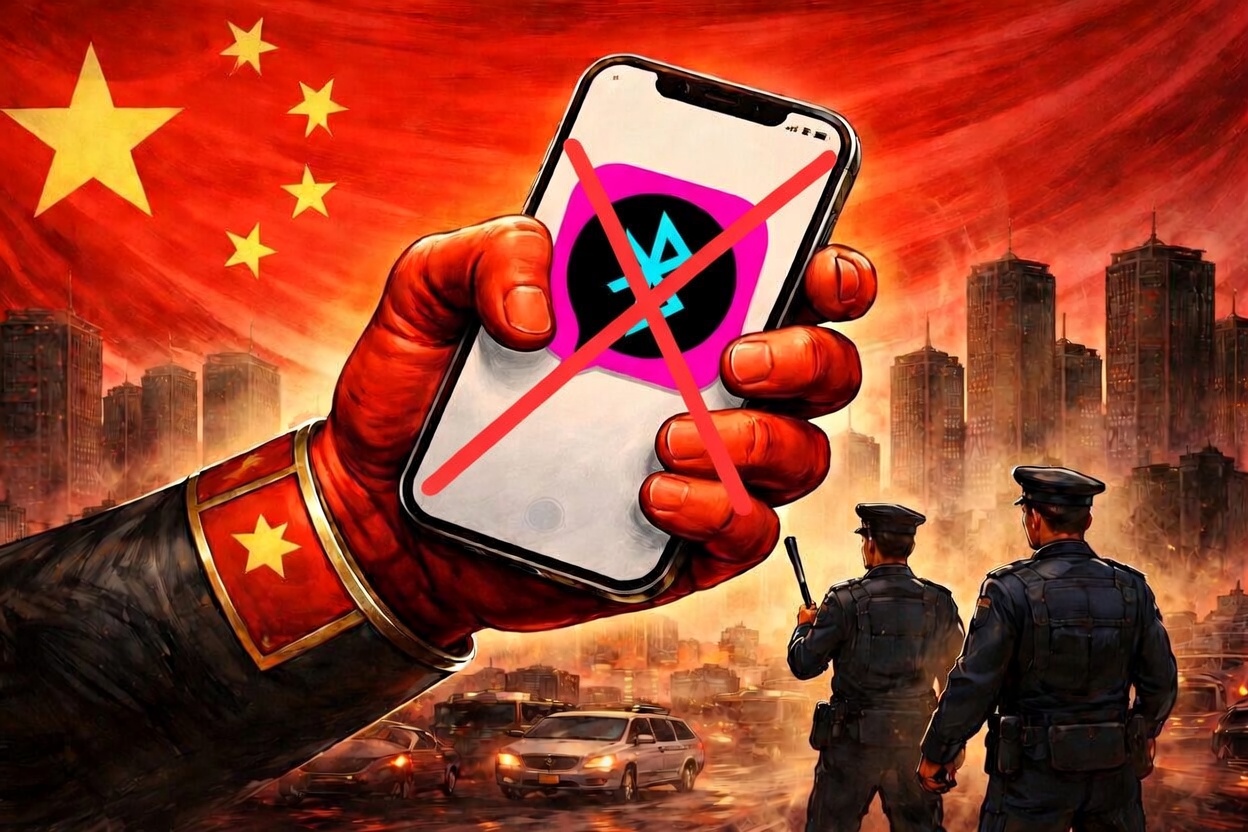
On April 5, Jack Dorsey posted a screenshot on X. Apple had sent Block a notification informing them that Bitchat had been removed from the China App Store at the request of the Cyberspace Administration of China.
bitchat pulled from the china app store pic.twitter.com/jrrd0gDrA9
— jack (@jack) April 5, 2026
The CAC’s reasoning was precise. Bitchat violates Article 3 of China’s provisions governing online services with “public opinion or social mobilization capabilities.” Under those rules, any service that could influence public opinion or enable social mobilization must undergo a state-mandated security assessment before launch.
Bitchat had not done that. More to the point, Bitchat could not do that. The app works by routing messages over Bluetooth and mesh networks with no internet connection required. It operates within a 30-meter Bluetooth range, using bridge nodes to link separate clusters. Messages are stored only in device memory, not on any central database. There is no server to regulate, no traffic to throttle, no IP address to block.
China’s internet firewall, the most sophisticated censorship infrastructure in the world, has no mechanism to reach it.
So China went to Apple instead.
What Bitchat Actually Is
Bitchat is a peer-to-peer encrypted messaging app built by Jack Dorsey’s Block. It requires no internet connection, no account, and no central authority of any kind. Two phones in Bluetooth range can communicate. Bridge nodes, phones with the app installed that are within range of two different clusters, connect those clusters into a larger mesh. The network expands organically as more devices join.
The app can also send Bitcoin. Not a reference to Bitcoin. Not a promise redeemable for Bitcoin. Actual Bitcoin, settled on the Lightning Network, transmitted between devices communicating over mesh. The censorship-resistant messaging protocol and the censorship-resistant money protocol share the same architecture because they share the same design principle: no trusted third party required.
Bitchat has been downloaded more than three million times across platforms, with over 92,000 downloads in the past week alone. The Google Play Store shows more than one million registered downloads separately.
Where It Has Already Been Used
The reason China moved against Bitchat is the same reason Iran labeled it a national security threat in January 2026.
Iran shut down its internet on February 28. What followed was the longest national internet blackout on record, 37 days during which less than one percent of the country had connectivity. NetBlocks, which monitors global internet access, described it as unprecedented. Iran had effectively reverted to a national intranet, cutting off its own citizens from the global network to suppress protests against the regime.
During those 37 days, Bitchat downloads among Iranians inside the country spiked. Mesh networks do not depend on any particular service provider, central router, or internet infrastructure. The Iranian government had severed every conventional communication channel it controlled. Bitchat worked because it does not use those channels.
The same pattern had played out in Madagascar, Uganda, Nepal, and Indonesia, where governments attempted to restrict internet access during periods of political unrest. In each case, Bitchat served as the communication tool that continued functioning after everything else was shut down.
Bill Ackman, the hedge fund manager, described Bitchat publicly as a useful tool in censored environments. That endorsement attracted attention. It also accurately described what the app was designed to do.
The Specific Limitation China Exposed
Here is what the China situation actually demonstrates, and it is worth being precise about it.
China could not ban Bitchat. The architecture makes that impossible. A government that controls every internet service provider, every cellular network, and every WiFi router in the country still cannot stop two phones communicating over Bluetooth in the same room.
What China could do is remove Bitchat from the App Store. That means new users in China cannot download it through official channels. Users who already have it installed can still use it. The mesh still works. The Bluetooth still works. China’s action slows adoption, it does not stop operation.
This is the specific limitation of censoring decentralized technology through centralized distribution channels. The distribution can be cut. The protocol cannot.
Apple’s compliance with this request follows an established pattern. In 2022, when Russia invaded Ukraine, Visa, Mastercard, and Stripe suspended operations in Russia within 72 hours of government pressure. In each case, the centralized intermediary, the App Store, the payment network, the bank, can be instructed by a government to stop serving users. The decentralized protocol underneath continues operating.
The Bitcoin Connection
Bitchat is not Bitcoin. But it is built on Bitcoin’s design philosophy, uses Bitcoin’s payment infrastructure, and was built by the person who has most publicly argued that Bitcoin is the most important development in his lifetime.
The connection matters because it illustrates what the Bitcoin community has argued for fifteen years: that censorship resistance is not a feature you add to a system. It is an architectural property. You build it in or you do not have it.
The Bitcoin Strategic Reserve exists because the people making long-term national financial decisions looked at an asset that no government has been able to confiscate, freeze, or stop in seventeen years of continuous operation. Bitchat exists because someone looked at that same design principle and applied it to communication.
China’s response proves the thesis. Beijing did not find a way to block Bitchat at the protocol level. It found the one centralized chokepoint in an otherwise decentralized system, the App Store, and applied pressure there. The protocol itself is untouched.
What Comes Next
Bitchat remains available everywhere except China’s App Store. The app continues to function in China for users who have it installed. Android users in China can still sideload the APK from sources outside the Play Store. The mesh network still works.
The Cyberspace Administration of China got what it asked for and less than what it needed. It removed an icon from a storefront. It did not stop the communication.
This is not a hypothetical argument about what decentralized systems might do someday. It is a live demonstration, happening now, of what they actually do when a government tries to shut them down.
Dubai closed its stock exchange when missiles hit the Gulf and Bitcoin kept trading. Iran shut down its internet and Bitchat kept working. China ordered Bitchat removed from the App Store and the mesh network kept running.
The pattern is consistent. The governments that try to shut these systems down are providing the clearest possible evidence of why they were built.