


Bitcoin is down 47% from its October 2025 peak of $126,000. Every headline is about the crash. The fear index is in single digits. Reddit is full of people asking whether the bull market is over.
Nobody is talking about the $316 billion sitting on the sidelines.
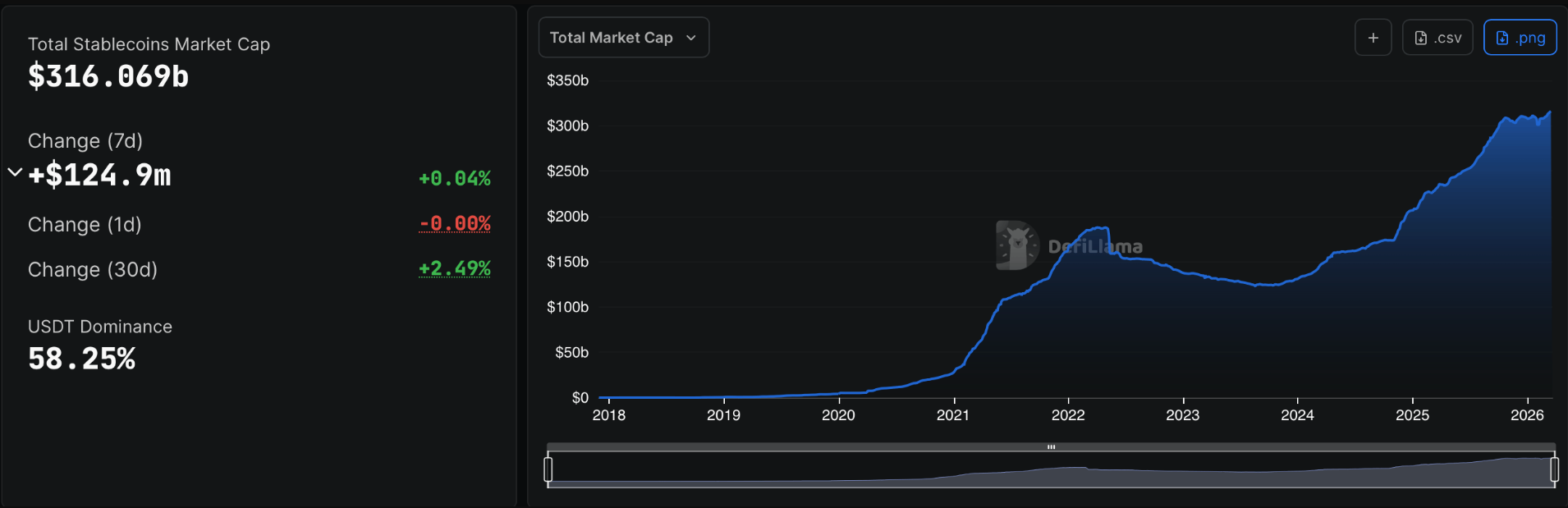
Stablecoin market cap hits $316 billion as of March 21, 2026. Source: Defillama
As of March 21, 2026, the total stablecoin market cap stands at $316 billion. The top five stablecoins control 89% of that figure, with Tether’s USDT alone commanding a $184 billion share. That number grew by $7.67 billion over the past month alone, a 2.49% increase, while Bitcoin was losing nearly half its value from peak. According to KuCoin, the stablecoin economy added $124.9 million in a single week earlier this month.
The question nobody is asking is what that money is doing there.
The Mechanics of Dry Powder
When investors move into stablecoins during a market downturn, there are two possible interpretations. Either they are exiting crypto entirely, converting to fiat equivalents before withdrawing to a bank account, or they are staying inside the ecosystem, parking capital in a safe haven while waiting for conditions to improve.
The $316 billion figure suggests the second interpretation is dominant right now. If investors were genuinely exiting crypto, that money would be flowing out of exchanges and into traditional banking. Instead it is sitting in USDT and USDC, assets that can be redeployed into Bitcoin in seconds. The infrastructure stays warm. The capital stays ready.
CoinDesk reported on March 10 that when Iran war panic briefly cooled, Bitcoin rallied past $70,000 in hours, rising over 4% in a single session. USDT supply had risen from its late-February low of $183.5 billion to $184 billion in the same period. The dry powder deployed. The price moved. The correlation was immediate.
That is how this works. The stablecoin supply is not a graveyard for dead capital. It is a loaded spring.
The $316 Billion Is Not What It Used to Be
Here is where the picture gets more complicated, and where most analysis stops short.
Not all $316 billion is dry powder waiting to rotate into Bitcoin. A significant and growing portion of the stablecoin market has permanently migrated into enterprise finance.
The GENIUS Act, signed into law in July 2025, created the first formal US regulatory framework for stablecoins. The result has been a structural bifurcation of the market. USDC, which is fully compliant under the new framework, grew 72% year over year to $75.3 billion. USDT, which operates outside the US regulatory perimeter, shrank from $186.8 billion to $183.6 billion in 2026 after Tether burned 6.5 billion tokens in January and February alone.
AInvest reported the key finding clearly: regulatory divergence is redirecting institutional liquidity away from unregulated assets and into compliant, reserve-backed stablecoins for payments and treasury use. Corporations are using USDC as a cash equivalent. Multinationals are settling cross-border transactions in stablecoins instead of wire transfers. That capital is not coming back into Bitcoin. It has permanently migrated into enterprise infrastructure.
So the honest read on the $316 billion is this: some of it is dry powder, some of it is not. The question is which portion is which.
Reading the Signal Correctly
The composition of stablecoin growth tells you more than the total number.
USDT gaining $115 million in a single week while USDC lost $150 million in the same period is an important signal. USDT is the stablecoin of choice for active crypto traders. USDC is increasingly the stablecoin of choice for institutional treasury operations. When USDT grows while USDC shrinks, that means trading-oriented capital is moving into safe haven positions inside the crypto ecosystem. That is classic dry powder behavior.
When USDC grows while USDT shrinks, as has happened over the longer trend of 2026, that means enterprise capital is flowing into compliant stablecoins for non-trading purposes. That capital is structurally different.
Right now the short term signal is bullish. USDT grew this week. Active traders are parking, not leaving. The longer term structural shift toward enterprise USDC is a separate dynamic that plays out over years, not weeks.
The Pattern That Has Played Out Before
Weekly stablecoin inflows jumped from around $51 billion in late December 2025 to roughly $102 billion by early February 2026, a 100% increase in six weeks. That happened while the total crypto market cap dropped 23% and Bitcoin slipped below $90,000. Capital did not leave. It parked.
What followed was not a straight line recovery, because the Iran conflict and macro pressure added new layers of uncertainty. But the underlying dynamic has been consistent throughout 2026. Bitcoin drops. Stablecoin supply grows. Bitcoin recovers. Stablecoin supply contracts slightly as capital rotates back in. Repeat.
The $316 billion is the largest version of that dynamic ever recorded. More capital is parked inside the crypto ecosystem right now than at any point in history. The fear index is at its lowest since the Terra collapse. The two things happening simultaneously tell you something important.
This is not a market that is giving up on Bitcoin. This is a market that is deeply uncertain about timing.
What Actually Moves That Money
Three things historically rotate stablecoin dry powder back into Bitcoin.
A macro catalyst that reduces uncertainty. The Iran conflict, oil prices above $100, and rising inflation have created the most uncertain macro environment since 2022. When any of those variables resolves, capital moves.
A technical breakout that forces momentum buyers in. Bitcoin holding $66,000 and reclaiming $70,000 convincingly would trigger the rotation. Losing $60,000 would send more capital to stablecoins, not less.
A regulatory clarity event. The GENIUS Act already did this for stablecoins. A similar framework for Bitcoin ETFs or digital asset market structure, which the CLARITY Act is still trying to deliver, would be the institutional unlock that moves the institutional portion of stablecoin capital.
None of those have happened yet. Until one does, $316 billion sits and waits.
The Bottom Line
The bear case for Bitcoin right now focuses on price. The chart looks bad. The macro looks worse. The headlines are relentless.
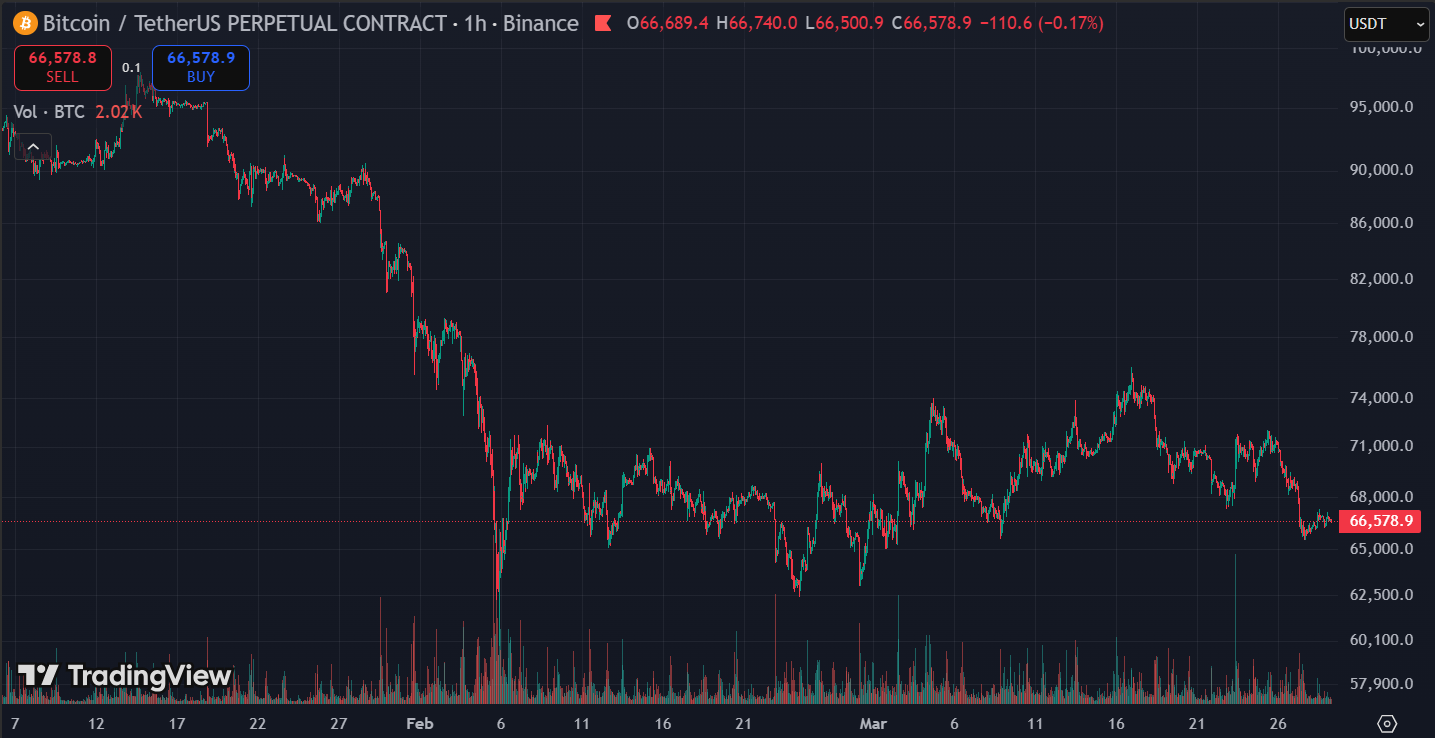
Bitcoin price chart March 29-2026 Source: TradingView
The bull case focuses on behavior. Capital is not leaving the ecosystem. It is accumulating at the highest levels in history. The largest pool of deployable crypto-native capital ever recorded is sitting in stablecoins, one macro catalyst away from rotating back in.
Both things are true simultaneously. The chart is ugly. The dry powder is real.
The $316 billion does not guarantee a recovery. It does not tell you when the rotation happens. What it tells you is that the people with the most money have not decided crypto is over. They have decided to wait.
That is a different signal than what the price action suggests. Whether you think it matters depends on which you trust more: the price, or the behavior of the capital behind it.