


Seven spot ETFs live. Goldman Sachs holding $153 million. The SEC and CFTC jointly classified XRP as a digital commodity nine days ago. Tomorrow is the final deadline for the remaining applications and Bloomberg analysts put approval odds at 95%.
XRP is trading at $1.37. Down on the day. Falling into what should be its biggest regulatory moment.
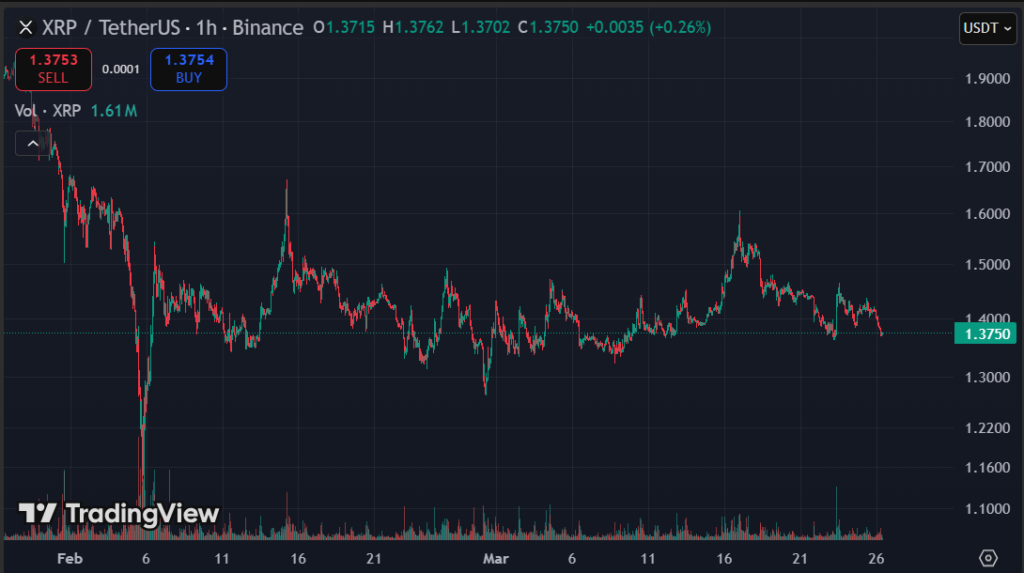
The XRP ETF deadline tomorrow, 95% probability approval, the Price Is Still $1.37 (Source: TradingView)
That gap between the regulatory story and the price is the actual story. And understanding why it exists tells you more about what the XRP ETF approval really means than any price prediction does.
What Happened to Get Here
The short version: XRP spent five years in regulatory purgatory after the SEC sued Ripple in 2020 for selling unregistered securities. Ripple eventually settled in 2025 for $125 million, a fraction of the $2 billion the SEC originally sought. Then on March 17, the SEC and CFTC issued a joint interpretive ruling classifying XRP as a digital commodity, putting it in the same legal category as Bitcoin and Ethereum.
That ruling cleared the path for spot ETFs. The first wave, Bitwise, Canary Capital, 21Shares, and others, launched in late 2025 and pulled in $1.44 billion in total inflows. Goldman Sachs built a $153 million position across four of them, making it the single largest institutional holder by a wide margin, bigger than the next 29 institutional holders combined.
Tomorrow, the SEC hits its 240-day maximum deadline on the remaining applications. Grayscale wants to convert its $2.1 billion XRP Trust into a spot ETF. Franklin Templeton is offering a 0.15% management fee, among the lowest in the space. The agency has little statutory ground to deny applications under a commodity classification framework it just issued.
All of that is true. The price is still $1.37 and dropping into the deadline.
The Number That Explains Everything
When the first XRP spot ETFs launched in late 2025, weekly inflows were running at $200 million. By early March 2026, that number had collapsed to under $2 million a week.
That is not a rounding error. That is the institutional wave that everyone assumed was coming, and hasn’t arrived.
Here is the comparison that matters: after Bitcoin’s spot ETF approval in January 2024, the institutional-to-retail ratio flipped within a year. Pension funds, family offices, and registered investment advisors drove consistent inflows that took Bitcoin from $40,000 to $126,000 over 18 months. Right now, 84% of XRP ETF assets still sit with retail investors. Sixteen percent institutional, after four months of trading.
Goldman Sachs is in. Millennium Management is in. The rest of the institutional capital that was supposed to follow them hasn’t moved.
Why Not
Three things are still unresolved.
First: the commodity classification that happened nine days ago is an interpretive release, not law. The CLARITY Act would make XRP’s status permanent under federal statute. That bill has been stalled in the Senate over a dispute about whether stablecoins should be allowed to pay yield. It has to clear committee by end of April or it’s likely dead for 2026. Senators Tillis and Alsobrooks reached an agreement in principle on the stablecoin language last week, and the Banking Committee is targeting a markup in the second half of April. Until that passes, the legal ground XRP is standing on is more stable than it was, but it isn’t bedrock.
Second: BlackRock hasn’t filed. The Bitcoin ETF became a different instrument the day BlackRock got in. iShares is the distribution mechanism that unlocks pension funds, sovereign wealth funds, and the wire house advisor channel at scale. Without a BlackRock XRP ETF on the shelf, those pools of capital don’t have a product they can access through their normal compliance framework. Nobody knows if BlackRock is coming. They haven’t said.
Third: total XRP ETF assets are roughly $1 billion right now, about 1.1% of XRP’s $88 billion market cap. Bitcoin ETFs hold close to $100 billion, closer to 5% of BTC’s total value. At current inflow pace, XRP ETFs don’t reach the scale needed to create meaningful supply pressure on the underlying token for a long time. The math only works if new money comes in significantly faster than it’s coming in now.
What Tomorrow Actually Is
Tomorrow is not a catalyst. It is the removal of uncertainty about one specific bureaucratic deadline.
If the SEC approves the remaining applications, which is the likely outcome, nothing structural changes. Seven spot ETFs become nine or ten. The institutions that are in stay in. The institutions that haven’t moved still haven’t moved. Grayscale’s trust conversion would be the most significant single event because it moves $2.1 billion into ETF structure in one action, which changes the product’s liquidity profile and fee structure. But it doesn’t create new buyers. It reorganizes existing ones.
If the SEC denies or extends, which would be the surprise, XRP probably drops toward the $1.20 support level that’s held through prior pullbacks. That scenario would signal something broke in the regulatory framework that everyone thought was settled.
The base case is approval, a brief price pop, and then a return to the underlying question: where is the institutional capital rotation that was supposed to follow the regulatory clarity?
The Thing That Actually Moves This
The CLARITY Act vote in April is more important than tomorrow. BlackRock filing would be more important than the CLARITY Act. Neither of those is happening tomorrow.
What’s happening tomorrow is the conclusion of a regulatory process that XRP already won. The question now is whether winning the regulatory fight was the cause of institutional adoption or just a prerequisite for it. Four months of ETF data suggest it was the prerequisite. The cause is still pending.
XRP got everything it asked for. The market is waiting to see if that was the right thing to ask for.