


On March 15, 2026, gold was trading at $5,131 per ounce. A week later it sits at $4,281 after touching $4,100. That is a 20% collapse in seven days. The worst weekly drop gold has seen in over four decades. The asset that spent years building a reputation as the ultimate safe haven just had one of the worst weeks in its modern history.
Gold hit an all-time high of $5,595 in late January. The war in the Middle East was escalating, the dollar was weakening, oil was climbing, and every financial pundit on television was explaining why gold was the only rational place to put your money in 2026. From that peak to today gold is down 24%. But the 20% that happened in a single week is the number that matters. That is not a correction. That is a collapse.
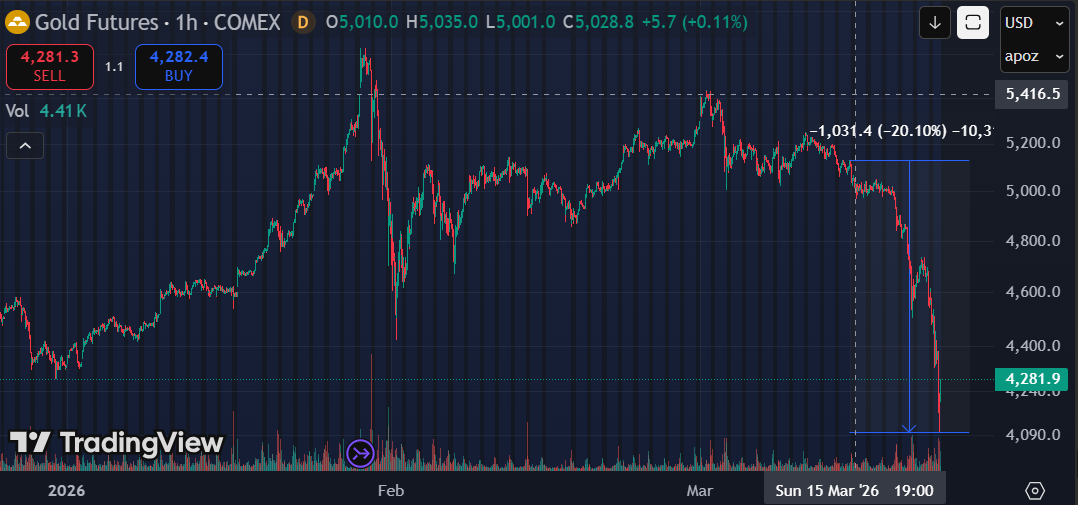
Gold futures down 20% in a single week, March 15-23, 2026. Source: TradingView
Bitcoin is at $68,000. Roughly where it was when gold was peaking.
Nobody predicted this sequence. Almost everyone got the narrative completely wrong. And Peter Schiff, gold’s most vocal evangelist, has logged onto X to explain why this all actually makes perfect sense.
What Happened to the Safe Haven
Gold’s collapse has a straightforward explanation that turns out to be deeply embarrassing for everyone who bought the safe haven story at $5,500.
The same geopolitical crisis that was supposed to make gold untouchable, the Iran conflict and the oil shock it triggered, turned out to be the exact mechanism that killed the rally. Higher oil means higher inflation. Higher inflation means the Fed cannot cut rates. The Fed staying hawkish means the dollar strengthens. A stronger dollar means gold sells off.
The asset that was supposed to protect you from inflation got destroyed by inflation. That is not a subtle irony. That is the mechanism working in reverse in plain sight.
As TheStreet reported, the Fed’s Summary of Economic Projections now shows just one rate cut in 2026, and with Brent crude above $108 per barrel and oil up more than 40% since the conflict began, that single cut is looking increasingly optimistic. Gold pays no interest. When real yields rise and rate cut expectations evaporate, holding the metal becomes increasingly expensive compared to Treasury bonds. One of gold’s primary tailwinds became a headwind almost overnight.
The rest was forced liquidation. When broad market sell-offs accelerate, investors sell what they can, not just what they want to. Gold had climbed 66% through 2025 and carried enormous embedded gains. As CNBC reported, “global markets have seen broad selloffs as investors search for the quickest assets to sell.” The perceived safe haven became the most obvious source of liquidity.
J.P. Morgan and Deutsche Bank are both maintaining their year-end targets of $6,300 and $6,000 respectively, calling this a tactical correction inside a structural bull market. They may be right. The structural case for gold, central bank buying at record levels for three consecutive years, de-dollarization, real rate dynamics, has not disappeared because of a two-month drawdown.
But the people who bought at $5,500 because gold was the safe haven during a war are sitting on a 25% loss while the war is still happening. That is worth sitting with for a moment.
Peter Schiff Has Some Thoughts
Peter Schiff, who has spent approximately thirty years telling anyone who will listen that gold is the only real money and Bitcoin is a fraud, posted this on March 23:
Selling gold because rising inflation will keep the Fed from cutting interest rates, when rates are already too low, makes no sense. Falling real rates are bullish for gold. It’s the stock market that needs rate cuts. That’s why it makes no sense that stocks are down so little.
— Peter Schiff (@PeterSchiff) March 23, 2026
This is technically coherent. Schiff is arguing that the market is mispricing the macro environment and that gold should be rising given the inflation picture.
He is probably right about the logic. He is just watching gold fall 25% while he explains why it should not be doing that.
This is the defining Peter Schiff experience. Impeccable macro reasoning delivered in real time while the price moves in the opposite direction. The man has been correctly identifying structural flaws in the US economy for decades. He has also been wrong about timing for most of those decades.
His Bitcoin commentary has been equally consistent throughout the asset’s journey from $100 to a $1.5 trillion market cap. Every price was the top. Every rally was irrational. The fraud was always about to be exposed. Bitcoin is up approximately 150,000% since he started warning about it.
Gold is down 25% this month. Schiff remains bearish on Bitcoin. The math is what it is.
What Bitcoin Actually Did
While gold was falling 25% from its peak, Bitcoin has been trading between $65,000 and $72,000. Not rallying dramatically. Not collapsing. Just existing.
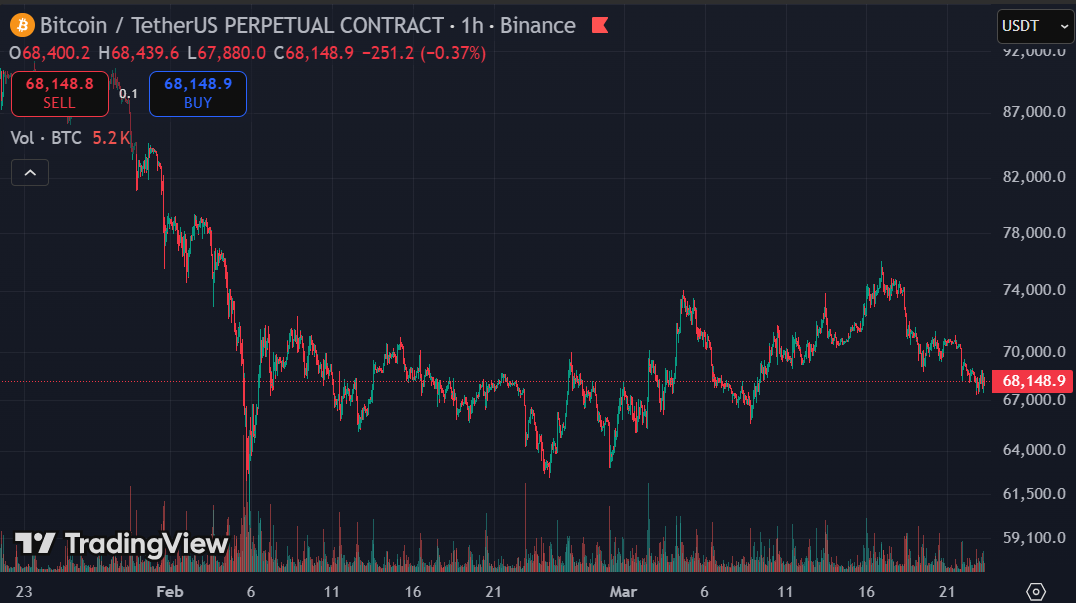
Bitcoin trading flat around $68,000 while gold collapsed 20% in the same week. Source: Binance
This is not the moonshot Bitcoin bulls predicted. The macro environment that should theoretically be Bitcoin-positive, dollar uncertainty, inflation concerns, geopolitical instability, has not produced a new all-time high. As we covered in our analysis of Bitcoin’s shift from risk asset to war hedge, this transition does not happen overnight.
What Bitcoin did do is hold. In a week where everything sold off, including the asset specifically designed to not sell off in these conditions, Bitcoin was the thing that held its value best.
Emirates NBD recently called Bitcoin digital gold and announced a formal allocation. That framing is being tested in real time right now. The institution that made that call is watching gold crater 25% while their Bitcoin allocation sits flat. It is too early to declare the narrative switched permanently. But the evidence this week points in one direction.
Bitcoin’s correlation with gold has been rising as institutional ownership increased. The theory was that institutions buying Bitcoin were treating it as a digital store of value. What happened this week suggests that theory has real merit. When gold got hit by a macro shock that specifically targeted safe haven assets, Bitcoin did not get dragged down with it the way it would have if it were purely a risk asset. It did not rally either. It simply held.
In a week like this one, not falling is the whole story.
The Narrative Has a Math Problem
The deeper issue with gold’s crash is not the price. It is what it does to the story.
As we noted when gold hit its all-time high and analysts were calculating what Bitcoin would need to reach equivalent valuations, the store of value competition between the two assets is a long game. A 25% drawdown in eight weeks does not end gold’s structural case. But it does reveal something important about how that case actually holds up under pressure.
The structural argument for gold is intact. De-dollarization is real. Central bank buying remains elevated. Real rate dynamics still favor non-dollar assets over a multi-year horizon. None of that prevented a 25% drawdown when the short-term macro story turned against it.
Bitcoin has had this problem in reverse for most of its existence. The structural argument for Bitcoin has been correct for fifteen years. The tactical reality has produced multiple 70% to 80% drawdowns along the way. Holders who understood the structural case and survived the tactical reality made extraordinary returns. Holders who arrived during a narrative peak and could not survive the drawdown did not.
Gold is currently having a Bitcoin moment. The long-term case is intact. The short-term price is doing something that makes the asset look unreliable to anyone who bought it recently for safety.
The tourists Kingswood Group managing director Paul Surguy referenced, “a lot of generalists, systematic hedge funds, and retail” who piled in during 2025’s 66% rally, are leaving. The long-term holders are staying. The reset may set up the next leg of the structural bull market that J.P. Morgan is targeting at $6,300.
Or it may not. Gold at $5,500 made the same argument. So did Bitcoin at $69,000 in November 2021.
Where This Leaves Both Assets
Gold’s structural case is not broken. Bitcoin’s narrative has not permanently won anything. What happened this week is a single data point in a much longer argument about what actually holds value when everything else is falling apart.
What that data point shows is specific and worth noting clearly. The war in the Middle East, the oil shock, the inflation impulse, the Fed staying hawkish, the dollar strengthening, none of those forces caused Bitcoin to collapse the way gold collapsed. It also did not cause Bitcoin to surge the way its advocates predicted.
Bitcoin just sat there at $68,000 while the safe haven that was supposed to be immune to exactly this kind of event fell 25%.
Peter Schiff thinks gold’s selloff is irrational and Bitcoin is still a fraud.
He has been saying something like that for a very long time.
Gold is down 25% this month. Bitcoin is flat.
The argument continues. The math holds.