


The people who have been through every Bitcoin crash since 2015 just sold $117 million worth of Bitcoin in a single day.
On March 19, Bitcoin’s long-term holder cohort distributed 1,650 BTC worth approximately $117 million following the Federal Reserve’s decision to hold interest rates and signal only one cut for 2026. The move came as Bitcoin was testing resistance at $74,400 for the fourth consecutive time without breaking through.
Long-term holders are defined by Glassnode as addresses that have held Bitcoin for 155 days or more. These are not traders. They are the people who bought in bear markets, sat through 80% drawdowns, and emerged on the other side. When they sell, it is worth understanding why.
This Is the Third Wave
This is not the first time long-term holders have distributed at scale in the current cycle. Glassnode data shows two previous distribution waves, each followed by significant price drops.
The first wave ran from late 2023 into early 2024. Long-term holders sold into strength as Bitcoin rallied from $25,000 toward its March 2024 all-time high near $73,000. That distribution preceded a 27% correction over the following months, with Bitcoin falling back to $53,000 by August 2024.
The second wave emerged in late 2024 when Bitcoin approached $100,000 on optimism around Trump’s election victory. Long-term holders distributed heavily into that rally. Bitcoin subsequently fell from $108,000 to $63,000 by February 2026 — a 42% drop.
The pattern is consistent across both waves: experienced holders sell into strength near resistance, new buyers absorb the supply, and when buying pressure fades, price finds its real support level.
The current situation is the third wave. Long-term holder supply has been declining for several weeks. The $117 million single-day distribution came at a specific trigger point: the Fed confirming that cheap money is not coming back soon.
Why the Fed Matters Here
Bitcoin has been trading in a compressed range between $63,000 and $74,400 since February. The US Strategic Bitcoin Reserve and institutional buying from Strategy and BlackRock have provided a floor. The ceiling has been set by macro conditions — specifically, the Fed.
When the Fed signaled only one rate cut in 2026, it reinforced what oil markets were already pricing in. Crude above $100, Iran conflict ongoing, inflation sticky. The environment where money flows freely into risk assets is not coming back this year. Long-term Bitcoin holders read that signal and acted on it within hours.
The 1,650 BTC sold in a single day represents a small fraction of total long-term holder supply, but the timing and the context are what matter. These are not panic sellers. They are systematic sellers who have done this before and have a track record of being early.
What the Historical Pattern Suggests
The 40% figure in the headline is not invented. It is drawn directly from the second distribution wave, when long-term holder selling from $108,000 preceded a drop to $63,000.
The first wave produced a smaller drop of roughly 27%. The average across both previous waves is approximately 35%.
Applying that range to the current situation: if this distribution wave follows the same pattern, Bitcoin’s downside target sits between $50,000 and $57,000. CryptoQuant analysts have identified $56,000 as a key realized price support level where bear markets have historically found floors.
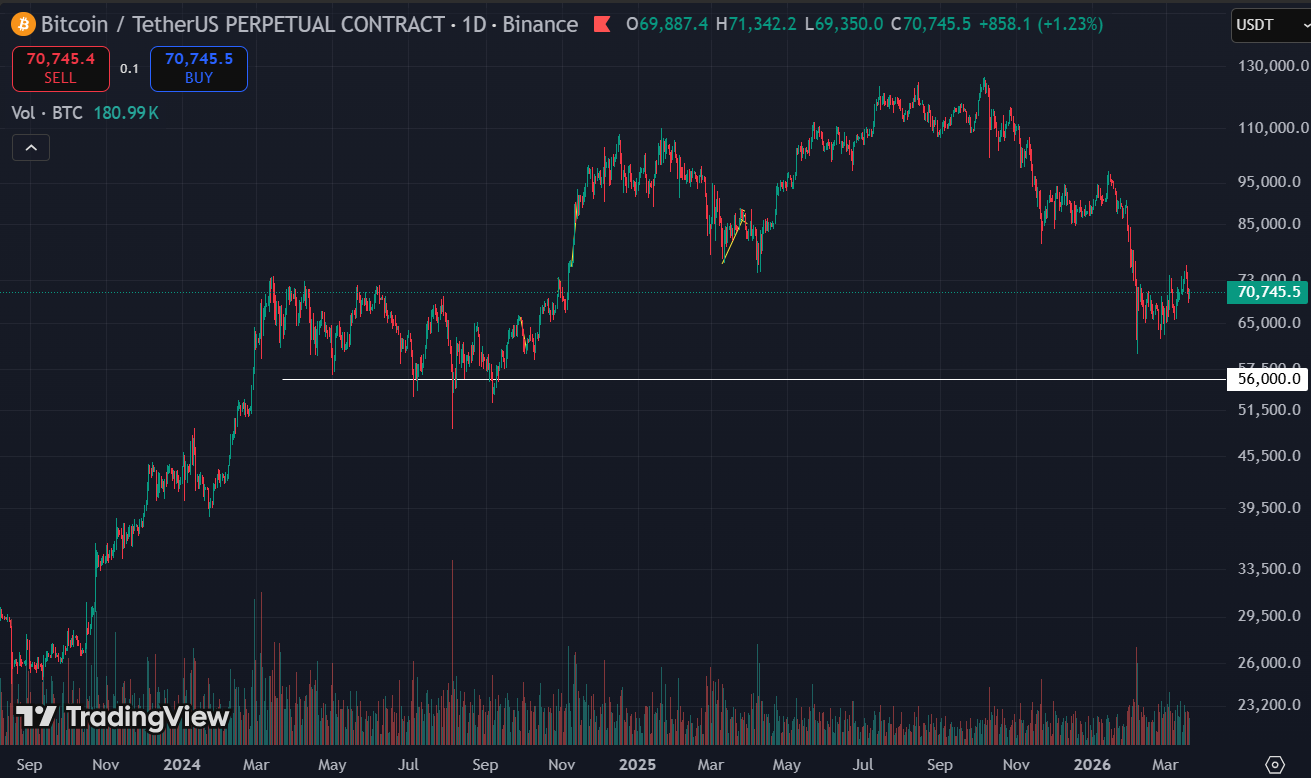
Bitcoin price chart showing resistance at $74,400 and long-term holder distribution pattern, March 2026. Source: TradingView
None of this is guaranteed. Each cycle is different. The presence of spot Bitcoin ETFs, the US Strategic Reserve, and institutional buyers like Strategy create demand floors that did not exist in previous cycles. Those buyers have absorbed significant supply during the current correction.
The Counterargument
Institutional demand is real and it is not going away.
Strategy held 738,731 BTC as of last week and has been buying consistently throughout the correction. BlackRock’s IBIT has seen net positive inflows for two consecutive weeks after four months of outflows. The US government is not selling its reserve position.
These are structural demand factors that long-term holder distribution has to work against. In previous cycles there was no institutional floor. Today there is. Whether that floor holds at $63,000 or gives way to $56,000 depends on how long the macro headwinds persist and how much supply long-term holders are willing to distribute.
The honest answer is nobody knows. What the on-chain data shows is that the people with the best track record of timing this market have started reducing exposure after the Fed’s signal. That is worth knowing, even if the outcome is uncertain.
What to Watch
The key level is $63,000. That is where Bitcoin bottomed in February after the Iran conflict spike down, and it represents the lower boundary of the current range. If long-term holder distribution continues and ETF inflows reverse, that level gets tested again.
Below $63,000, the next significant support identified by on-chain analysts sits around $56,000. That is where the realized price of a large cohort of buyers sits, and historically it has acted as a bear market floor.
The Bitcoin mining difficulty drops on March 20, providing some relief to miners who have been operating at or below breakeven. That removes one source of forced selling from the market. It does not change the macro picture or the long-term holder distribution data.
Long-term holders have been right before. They were right in early 2024. They were right in late 2024. The third wave is underway. Whether history rhymes precisely or only approximately, the direction of their conviction is clear.