

Five days into the US-Iran war, Bitcoin has run the same play three times.
Escalation hits. Bitcoin drops hard. Panic moves through the market and leveraged longs get liquidated. Then the dust settles, buyers return, and Bitcoin recovers most of what it lost — sometimes all of it.
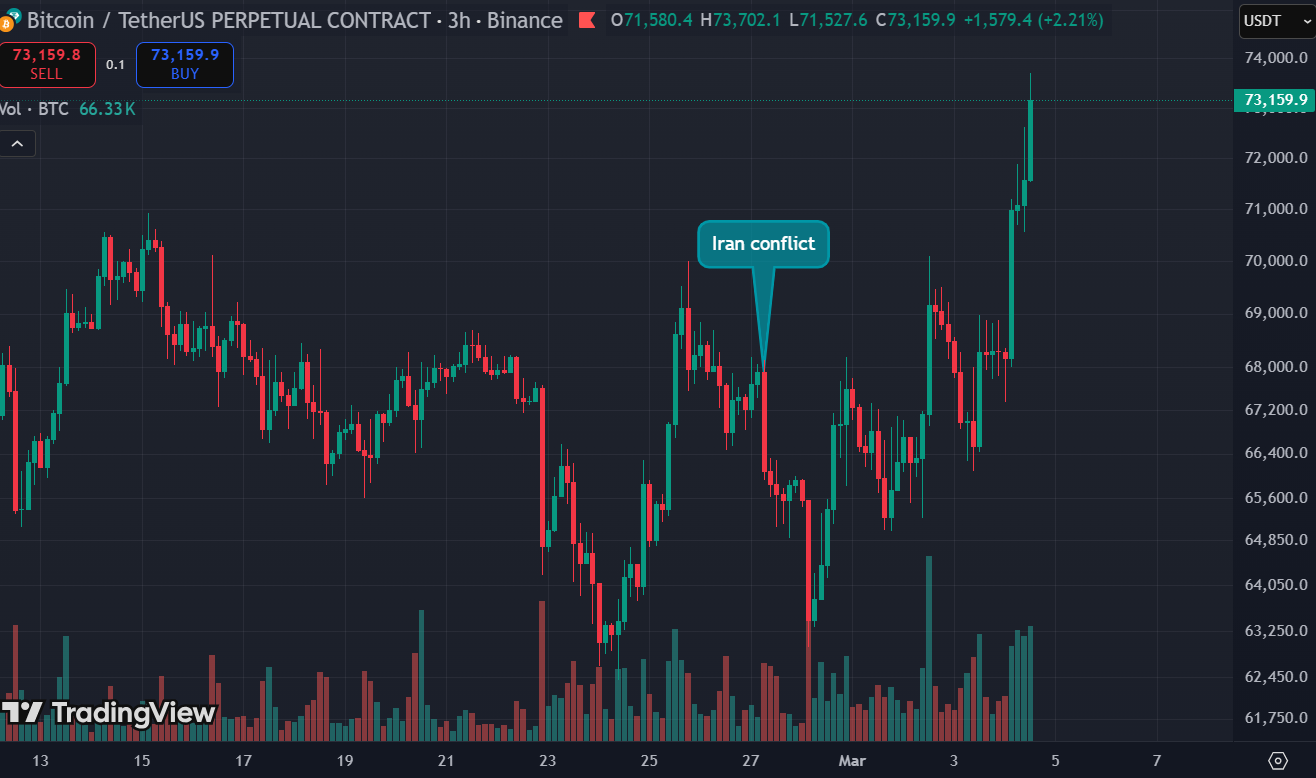
It happened when the first strikes landed Saturday. It happened when Iran hit Saudi oil infrastructure Monday. It happened again Tuesday as war jitters pushed Bitcoin back into the high-$60,000s. And today, Wednesday, Bitcoin climbed back above $73,000 for the first time since the conflict erupted, staging a roughly 9% recovery from Wednesday lows near $66,800.
The conflict is not over. But Bitcoin’s pattern through it is becoming readable.
What’s Actually Happening
The numbers this week: Bitcoin opened the conflict around $69,000, fell to near $63,000 when news of the US and Israeli strikes first broke Saturday, bounced above $68,000 after news broke that Iranian Supreme Leader Khamenei had been killed, pulled back again as Iran retaliated against Saudi oil infrastructure, and has now recovered to $73,000 on signals that the most intense phase of the campaign may be winding down.
Trump’s comments that “the hard part is done” and offers of reconstruction aid fueled optimism that Strait of Hormuz tanker traffic might resume within days. Oil, which had surged above $84 a barrel at its peak, pulled back. Bitcoin followed oil down during the panic and is now following the de-escalation signal up.
The geopolitical escalation triggered $300 million in long position liquidations — a contained selloff compared to the $2.5 billion in leveraged longs wiped out during early February. QCP Capital noted that traders appear to have already lightened positions in preceding weeks, which is part of why the drops didn’t turn into something worse.
The Pattern That Keeps Repeating
In 2022, during the Russia-Ukraine conflict, Bitcoin initially dropped before rallying 40%. In 2025, during Israel-Iran tensions, it fell before rebounding 25%. Now in 2026 it’s doing it again, and without widespread capitulation — on-chain data from CryptoQuant shows declining loss-driven transfers to exchanges, even after Bitcoin dipped below $65,000.
The people who were going to panic-sell have already sold. The people still holding are either long-term holders who don’t blink at a 10% war drawdown, or buyers who showed up specifically because of it.
That is a different market than the one that existed in 2022.
The Honest Argument Against the Safe Haven Story
We covered this question directly when the conflict first broke out. The short version: Bitcoin’s wartime track record is genuinely mixed. Some argue that Bitcoin remains a risk asset, and “digital gold” is merely a slogan that has not gained recognition from capital markets. That is a fair read of the short-term price action.
But there is a different way to look at it. The question is not whether Bitcoin goes up when a war starts. The question is whether the floor keeps moving higher each time. In 2022 the bottom was $34,000. In 2025 the bottom held around $75,000 before the conflict. This week the bottom was $63,000 on a war in the world’s most important oil-producing region — and it recovered in days.
Bitcoin hovered around $68,000 on Tuesday, erasing gains it made Monday, as a broader selloff in risk assets deepened amid fears the Iran war will continue to escalate. Then it found buyers anyway. That is not the behavior of an asset with no floor.
What Comes Next
Key support now sits at $71,000–$71,500, with resistance at $74,000 cycle high from late February. If Brent stabilizes below $85 and Iran headlines stay constructive, analysts eye a push toward new all-time highs by week’s end. Renewed Hormuz blockades or Iranian counterstrikes could easily retest $68,000.
BitMEX co-founder Arthur Hayes made the case that the longer the US remains involved in the Iran situation, the more likely the Fed is to cut rates or print money to support war spending — which would be a potential tailwind for Bitcoin. That is a different kind of bullish thesis than the safe haven story: not that Bitcoin rises when things get bad, but that governments’ response to things getting bad tends to be inflationary, and Bitcoin benefits from that over time.
While that plays out, the structural point from last weekend still stands. Dubai closed its stock exchange. Bitcoin didn’t. That is the baseline. Everything else is noise on top of it.
The conflict is now five days old. The most realistic window for major operations ending is late March to mid-April, assuming escalation stays contained. A lot can change. But five cycles of drop-and-recover in five days has given the market a data point it didn’t have last week: whatever the floor is, it’s not zero.
Sources:
- Bitcoin Slides as Risk of Prolonged Iran War Weighs on Crypto — Bloomberg, March 3 2026
- Bitcoin Price Stabilizes After Iran Conflict Sparks $300 Million in Liquidations — Yahoo Finance, March 2 2026
- Bitcoin Surges Above $68,000 Amid Muted Stock Market Reaction to Iran War — CoinDesk, March 2 2026
- Bitcoin, Cryptos Under Pressure as Oil Spikes 6% — CoinDesk, March 2 2026