

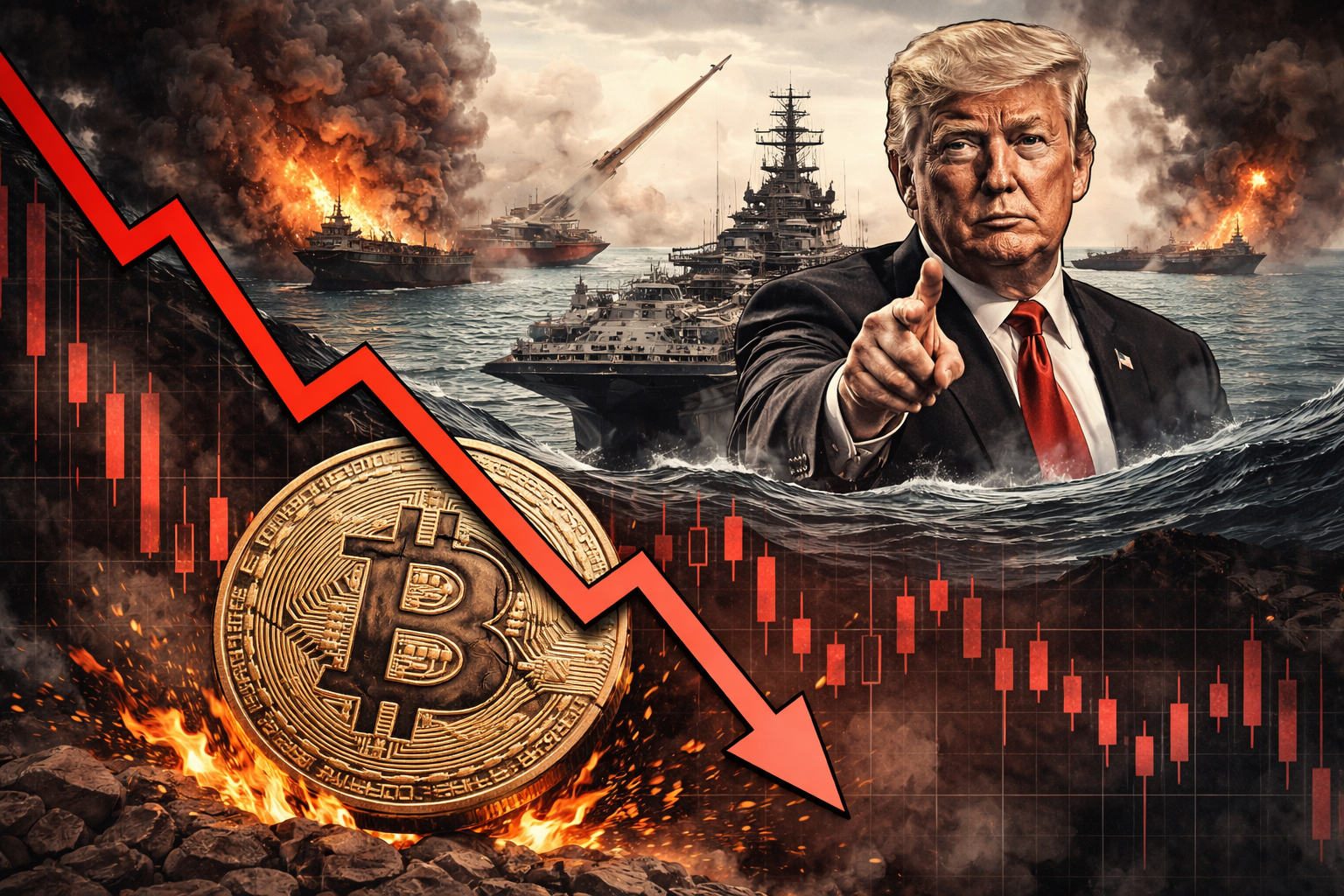
The talks in Islamabad lasted 21 hours. They ended without an agreement.
Vice President JD Vance walked out of the negotiations Saturday and told reporters: “The bad news is that we have not reached an agreement. And I think that’s bad news for Iran much more than it’s bad news for the US.”
Hours later, Trump posted on Truth Social: “Effective immediately, the United States Navy, the Finest in the World, will begin the process of BLOCKADING any and all Ships trying to enter, or leave, the Strait of Hormuz.”
Oil jumped 7% on Hyperliquid, the only major trading platform open on a Sunday. Bitcoin dropped below $71,000. The brief ceasefire trade that pushed Bitcoin from $66,000 to $73,000 this week is unwinding in real time.
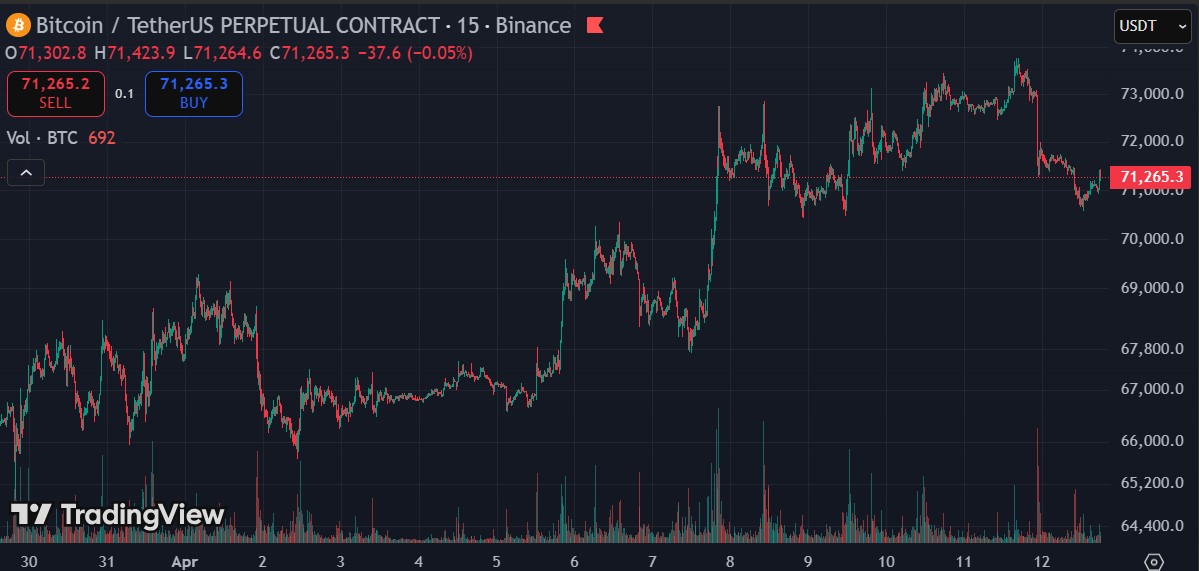
Bitcoin Price April 12 Source: TradingView
What Broke the Talks
The sticking point was nuclear. Everything else in the negotiation had moved — Iran’s demands around frozen assets, war reparations, regional ceasefires, even partial discussions around the Strait of Hormuz. But Tehran would not commit to abandoning its nuclear program, and Washington would not sign an agreement without that commitment.
“We haven’t seen that yet. We hope that we will,” Vance said of Iran’s willingness to give up nuclear ambitions.
Iran’s position was equally firm. Its foreign ministry said the two sides “reached an understanding on a number of issues, but ultimately the talks did not lead to an agreement.” Tehran has maintained throughout the conflict that its nuclear program is civilian and that enriching uranium is a sovereign right.
Pakistan, which hosted the talks and has served as a key mediator throughout the war, urged both sides to maintain the ceasefire spirit and continue negotiations. Oman’s foreign minister posted that “success may require everyone to make painful concessions, but this is nothing as compared to the pain of failure and war.”
Both appeals landed in the same moment Trump was announcing a naval blockade.
What the Blockade Means for Oil
The Strait of Hormuz has been effectively closed since the war began on February 28. Emergency stockpile releases from the IEA and member governments have been offsetting a supply shortfall of roughly 4.5 to 5 million barrels per day. Those buffers are running down.
Energy analysts warn that if the strait remains closed, the gap could widen to 10 to 11 million barrels per day — what the House of Saud has described as “a supply shock without precedent in the modern oil market.” Karen Young at Columbia University’s Center on Global Energy Policy told CNN that elevated oil prices are now likely “into the end of 2026” regardless of when the war ends, because even after a ceasefire the strait needs to be cleared of mines and damaged oil infrastructure needs to be repaired.
Trump’s blockade adds a new layer to this. The US Navy will not just clear mines — it will interdict vessels that have paid tolls to Iran. Iran was attempting to charge passage fees through the strait as a revenue mechanism during the ceasefire. Trump called this “world extortion.” The blockade is designed to cut off that income stream and pressure Iran’s economy while military action is paused.
Two US guided-missile destroyers, the USS Frank E. Peterson and USS Michael Murphy, already transited the strait on Saturday for mine-clearing operations. Iran’s Revolutionary Guard warned that military vessels approaching the strait would be considered in violation of the ceasefire and dealt with severely. Iran simultaneously denied having placed mines while warning against attempts to clear them.
The ceasefire status is now genuinely uncertain.
What Bitcoin Does From Here
We wrote earlier this week that Bitcoin at $73,000 was the market saying the ceasefire was more likely than not. Bitcoin failing to break $73,000 was the market saying it was not certain enough to bet on it.
The ceasefire has now functionally broken down. The price is reflecting that.
Bitcoin liquidations jumped 89% in the past 24 hours. The broader crypto market dropped 1.72%. The pattern is the same one that has played out every time this conflict escalated: Bitcoin absorbs the fear first because it is the only liquid asset trading on a Sunday morning when traditional markets are closed.
The question now is whether this is a temporary escalation before a new round of negotiations or a genuine return to active conflict. Vance left the door open, saying the US had delivered its “final and best offer” and that it would see if Iran accepts. Iran said it would continue diplomatic efforts. Pakistan said it would keep mediating.
The oil market is pricing in the worst case. Bitcoin is somewhere in the middle.
What has not changed: the Strait of Hormuz remains the axis around which this crisis turns. 20% of the world’s oil moves through 21 miles of water. That number has not moved since the war started. Neither has the underlying logic of why Bitcoin exists as an alternative to financial infrastructure that governments can close when missiles start flying.
Dubai shut its stock exchange. The Islamabad talks collapsed. The US Navy is blockading Hormuz. Bitcoin is still trading.