


Last Wednesday, Jerome Powell told markets inflation was heading to 2.7%. Six days later, the data disagreed.
The March flash PMI landed today and the picture it painted was not the soft landing the Fed has been promising for two years. According to the official S&P Global press release, the Composite PMI fell to 51.4, an 11-month low, consistent with annualized GDP growth of just 1.0%. At the same time, price gauges point to consumer inflation re-accelerating toward 4%. Slower growth. Rising prices. One word for that combination and it is not a word anyone in Washington wants to say out loud.
Stagflation is back.
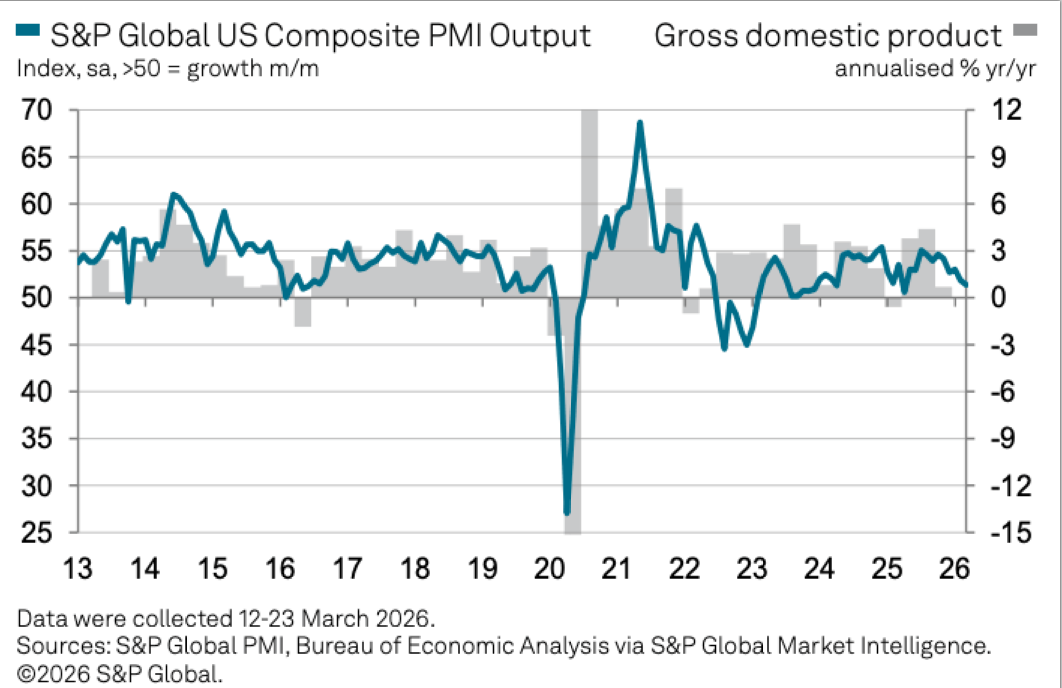
S&P Global’s flash US Composite PMI fell to 51.4 in March 2026… (Source: S&P Global)
What the Data Actually Shows
The split inside the PMI number tells the real story. Manufacturing surprised to the upside, hitting 52.4, a two-month high. Factories are rebuilding safety stocks, bracing for supply chain disruption from the Iran war. That is not strength. That is stockpiling before a disruption arrives.
Services collapsed to 51.1, an 11-month low. Travel, transport, tourism. The parts of the economy people actually feel in their daily lives. S&P Global’s chief business economist Chris Williamson said it directly in the official release: the survey data “signal an unwelcome combination of slower growth and rising inflation following the outbreak of war in the Middle East,” with price gauges pointing to consumer inflation accelerating back toward 4% and “hinting at a growing risk of the US moving into an environment of stagflation.”
The Iran war is doing two things simultaneously. It is pushing oil above $100, feeding directly into input costs and consumer prices. And it is destroying confidence in services, travel and exports, which is bleeding growth. You cannot fix both problems with the same interest rate decision.
That is the trap.
The Fed Has No Good Move
Polymarket traders now assign a 31.2% probability to zero rate cuts in 2026, with 58% combined probability of just zero or one cut, a sharp reversal from expectations just weeks ago, according to Benzinga. Markets see a 97.8% chance inflation exceeds 3% this year and a near coin flip that it breaches 4%.
Cut rates into 4% inflation and you risk reigniting price pressures that are already accelerating. Hold rates in a 1% GDP growth environment and you risk choking an economy that is already losing momentum. The probability of a US recession by end of 2026 now sits at 35%.
As we wrote last week, Powell raised his inflation forecast to 2.7% at the March 18 FOMC meeting. The PMI data released six days later points to 4%. That is not a rounding error. That is the Fed being unable to model an economy being reshaped by a war it did not price in.
Powell leaves in 57 days. Kevin Warsh inherits this. There is no clean handover.
Why Bitcoin Was Built for Exactly This
Every central bank in the world right now faces some version of the same problem. Inflation they cannot fully control, growth they cannot fully protect, and a political mandate that makes honest policy nearly impossible.
Bitcoin was designed for the moment when those contradictions become undeniable.
Institutional buyers have not missed this. While retail has been in extreme fear, whale wallets accumulated 270,000 Bitcoin over 38 consecutive days. Exchange reserves sit at seven-year lows. The people with the most money and the best models have been quietly removing Bitcoin from the market during the exact months the stagflation data was building.
This is not a coincidence. It is a positioning decision.
Bitcoin does not have a central bank adjusting its supply when the political pressure gets uncomfortable. It does not have a press conference where a chairman explains why the projections were wrong again. The difficulty adjustment runs on schedule. The halving runs on schedule. The supply cap does not move because oil went to $100 or because a PMI print came in below expectations.
That is not an ideological statement. It is a mechanical one. And in a stagflationary environment where every fiat denominated asset is hostage to a policy decision that has no good options, mechanical predictability has a price.
Where Bitcoin Sits Now
Bitcoin is at approximately $71,000. Down from the $74,000 range before the Iran conflict escalated, but holding above the $63,000 low from when the war began on February 28. Every macro input right now, oil above $100, PMI signalling stagflation, the Fed frozen, the war with no clear endpoint, is the environment Bitcoin’s long-term holders have been waiting to be proven right in.
The short-term price action is noise. Liquidations, geopolitical tweets, deadline extensions. That is the market pricing information it has.
The structural case is different. Every PMI that prints slower growth and faster inflation, every FOMC meeting where Powell or Warsh has no clean move, every oil spike from a conflict nobody knows how to end, adds one more data point to the argument that having an asset outside the system is not paranoia.
It is portfolio construction.