


For three weeks, Bitcoin did something nobody expected. Every time the Iran conflict escalated — and it escalated repeatedly, each time harder than the last — Bitcoin’s floor moved higher, not lower.
It was a clean pattern. Almost too clean. And today, for the first time since the war began, it is being tested.
The Pattern That Formed
February 28: Operation Epic Fury launched. 900 strikes in 12 hours. Khamenei killed. Bitcoin was the only liquid market open on a Saturday morning and it absorbed the full shock, dropping from $78,500 to $62,000 in the opening hours.
Then it bounced. And the bounces kept coming, each one from a higher floor than the last.
March 2: Iranian missiles hit the UAE. Dubai and Abu Dhabi closed their exchanges. Kuwait suspended trading. Bitcoin recovered to $68,000. March 7: Iran launched 500 missiles and 2,000 drones — its largest military operation ever. Bitcoin held $66,500. March 12: tanker attacks near Basra. Bitcoin climbed through $70,000. March 17: Bitcoin hit $74,700, up 11% from its war-day lows, while the S&P 500 was down 4%.
Each escalation larger. Each floor higher. By mid-March, analysts were calling it Bitcoin’s war hedge moment — the live proof that institutional buyers were treating every geopolitical panic as an entry point.
What Changed This Week
March 19: Iran struck the Ras Laffan LNG facility in Qatar. Billions in infrastructure damage. One of the world’s most critical energy sites hit directly. Bitcoin dropped 5.4% to $70,500.
It recovered. But something was different. The $73,000–$74,000 level has now been rejected four times. Today, March 21, Bitcoin is at $70,537, sitting exactly at the floor level the pattern needs to hold.
The Strait of Hormuz is still under threat. Brent crude is near $100. The Federal Reserve has ruled out rate cuts through mid-2026. And for the first time since the war began, Bitcoin is not making higher lows, it is testing the last one.
What the Ukraine Chart Warns
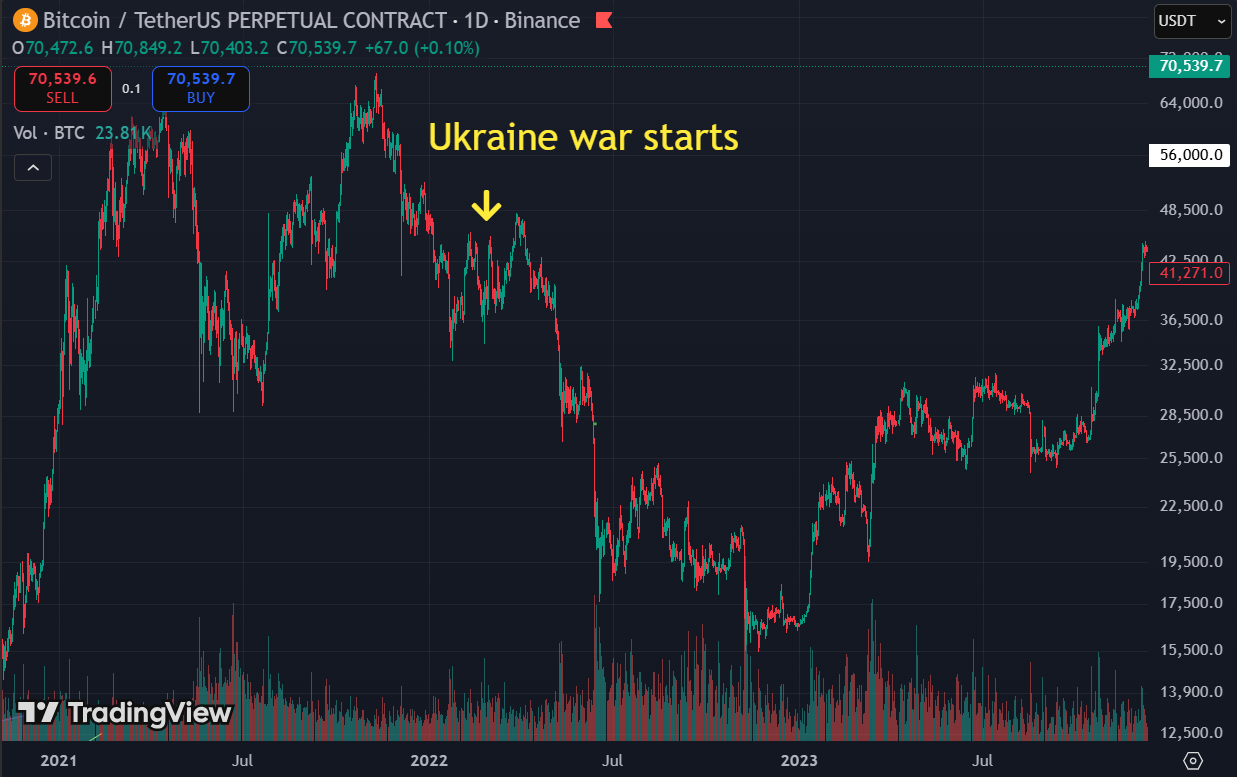
When the Ukraine war floor broke in 2022, Bitcoin lost 75% over 12 months. The Iran war chart is three weeks old. Source: TradingViewThe Ukraine chart is the reference point nobody wants to look at too closely right now.
When Russia invaded in February 2022, Bitcoin was already in a downtrend. The war hit, Bitcoin fell roughly 21% in the first weeks — almost identical to the Iran war’s opening move. The difference is what happened next. In 2022, the floor never held. Every recovery was sold. Bitcoin went from $44,000 at the start of the Ukraine war to $16,000 over the following year.
The Iran war chart, three weeks in, looks different. Same initial drop. But the floors have been rising, not falling. The question is whether that continues or whether this week marks the point where the two patterns converge.
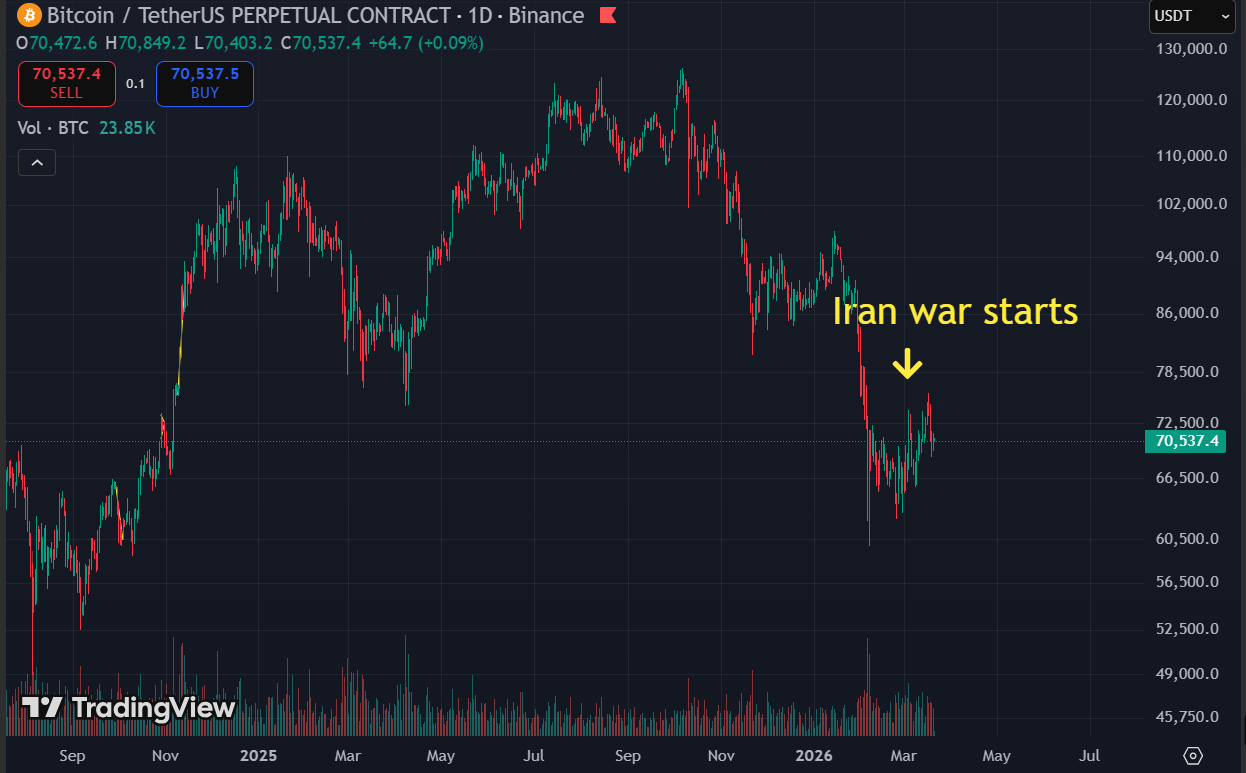
Bitcoin builds higher lows after each Iran escalation — from $62,000 on February 28 to $70,537 today. Source: TradingView
Why the Floor Has Held — And Why That Might Not Be Enough
The institutional buyer thesis explains the rising floors. In 2022, Bitcoin had no US Strategic Bitcoin Reserve. There were no nation-states competing to accumulate. Citi had not built custody infrastructure. Emirates NBD had not called it digital gold. Every dip in 2026 is being caught by a different class of buyer than existed four years ago.
But institutional buyers have allocation mandates, not unconditional support. If the conflict drags into month two and three, if oil stays elevated, if rate cuts stay off the table, if equity markets keep deteriorating, even patient institutional money has limits.
The pattern has held for three weeks. That is longer than most people expected on February 28. Whether it holds for three more weeks depends on whether the war becomes a new normal that markets price in and move past, or whether it becomes the kind of slow-burning pressure that the Ukraine war eventually became.
$70,000 is the line. It has held. It is being tested right now.
The Iran war chart is still being written.
Sources:
- Qatari Stocks Slide as Iran Retaliates, Abu Dhabi and Dubai Markets Shut — Reuters, March 2 2026
- Bitcoin Sold Off First When the Iran War Began. Two Weeks Later It’s Outperforming Nearly Everything — CoinDesk, March 14 2026
- Bitcoin Holding at $70,000 as Iran War Stokes Inflation Concerns — Bloomberg, March 20 2026